Although the Morrill-Smith Addition to Reno was platted in 1904, its eastern edge was pretty remote.
Map: Washoe Regional Mapping System
Joseph J Parent was the first buyer of Lots 4-6 on Fourth Street just west of Toano in March of 1905. It took a few years for development to really progress, as shown in this aerial photo from 1908. For reference, the Flanigan Warehouse is on the left with Reno Brewing Company in the center. The area east of the brewery was still sparsely populated.
The lots were eventually sold to individual buyers who built rental homes at what became 1231 and 1233 E. Fourth. The east lot was used for various commercial purposes. Harold and Ella Tamka bought the two residental lots in May of 1945. Harold was a painting contractor who also served as President of the Reno YMCA.
The west lot became occupied by Al and Ruth Maler, who operated Reno Trailer Rentals beginning around 1947.
Nevada State Journal, June 20, 1947, 14. Newspapers.com.
That September, a building permit was issued to Ross V McGuire for an auto court on the west lot estimated to cost $25,000. After Al Maler died, McGuire was also listed with Ruth in connection with the trailer business. In November of 1947, a permit was issued to move the house on the east lot to Sierra Street and the trailer business was listed for sale with all equipment at the beginning of 1948. Finishing touches including heating systems were installed that summer.
Auto courts, also called auto camps, tourist courts, motor courts, etc. began falling out of the vernacular with the rise of roadside motels. Maler and McGuire settled on Hi Ho Motel as the name for their 11-room establishment. At that time, the motel only had one long wood frame building. The majority of the structure consisted of a single story with a second-floor office near the front.
Kurt E Riedel bought the Hi Ho in November of 1949 and hired architect Ralph A Casazza to design a new addition on the east lot, which was planned to be built in stages. Construction began in March of 1950 and the facility was fully air conditioned as part of the project. Riedel is holding the shovel on the left and Casazza is on the right.
Reno Evening Gazette, March 15, 1950, 3. Newspapers.com.
The 1950 addition is shown on the right around 1951 when the motel used only a four-digit telephone number of 4256. At that time, the Hi Ho Motel advertised as a “new, fully modern 21 unit carpeted motel with tubs or tile showers. Circulating hot air, vented heat. Free radios in each unit.”
Postcard: A “Colourpicture” Publication, K3335, circa 1951. Author’s collection
Riedel acquired the corner lot where the tire shop had been located in January of 1952 and was issued a permit for the next expansion phase, which was estimated to cost $42,000. This would give the Hi Ho a total of 32 rooms. The addition facing Toano Street opened that May.
Reno Evening Gazette, May 16, 1952, 15. Newspapers.com.
A sketch of the completed facility is shown here with a western-themed mural on the side of the east annex.
State of Nevada Telephone Directory August 1952, 129. Bell Telephone Company of Nevada.
It would have looked better if they had matched the roofing materials but I understand things cost money.
Ernest Collins bought the motel around 1959 and it became known as the Hi Ho Motor Lodge. It appears he only owned the property for a few years and it has changed hands numerous times over the decades. In the mid-1980s, the Hi Ho advertised having waterbeds in some of the rooms. What could have possibly gone wrong?
The illuminated Hi Ho Motor Lodge sign is shown here in 1986. For many years, the upper and lower sections of the sign were painted red with a dark blue or black center.
pho003929. Neon in Nevada Photograph Collection, 0225_0456. Special Collections and Archives, University Libraries, University of Nevada, Las Vegas. Las Vegas, Nevada. https://special.library.unlv.edu/ark:/62930/d1cj87k29
As you all know, things happen in Fourth Street motels. In November of 2018, a “mysterious explosion” at the Hi Ho sent a man to the hospital. A man was shot in the chest outside the motel in January of 2022.
The Hi Ho’s Facebook page hasn’t been active since 2023 but it does include some interior photos. It also includes in its description that pets are not allowed. The usual complaints I see when researching old motels are related to poor living conditions and pests. In this case, it’s mostly about pets. People really seem to like the facility and the owner but really wish pets were allowed.
This is how the former Hi Ho Motel looks today:
Photo by Anna King
Photo by Anna King
Photo by Anna King
Photo by Anna King
Photo by Anna King
Photo by Anna King
Photo by Anna King
The original building is showing its age but it’s clear the owner has been putting money into the property. YESCO has recently maintained the sign, which was retrofit with LED bulbs. The parking lot has been refinished and stucco repairs appear to be in progress. Look, I don’t know what this place is like after dark but a need is being met here and the property was neat and tidy the day I visited. Despite what certain developers keep telling us, demolition isn’t the only option.
If you like what you see, be sure to subscribe (way at the bottom of the post on mobile devices) to receive an email each time a new post is published and share on social media. You can also support my work by donating below. This content is 100% funded by history fanatics such as yourself. Thanks for reading!
Donation
Your support keeps the content flowing! Make a one-time donation. Your contribution is appreciated!
I started this Then and Now series because I kept seeing photos of people and places in my hometown which were completely unfamiliar. I shared this image in a batch of “Mystery Monday” photos of unidentified individuals on the Ford County Historical Society’s Facebook page back in October of 2023.
Photo: Ford County Historical Society Dodge City Daily Globe Collection
Warren Bowles let me know that was his grandfather, Claude Guliford, and sent some photos of the family’s restaurant and tavern north of Wright Park. Warren didn’t have an exact location and I’ve been trying to figure it out ever since.
Claude and Lillie (White) Guliford originally lived in Sterling and owned the Guliford Truck Line, which they established in April of 1920.
Sterling Kansas Bulletin, July 7, 1921, 8. Newspapers.com.
The family moved to Raton, New Mexico where their son, Charles, was born in 1925. At that time, Lillie was the community correspondent for The Chicago Defender newspaper.
By the Spring of 1928, the Gulifords had moved to Dodge City. This was during Prohibition and that May, Claude was accused of brewing beer for sale at home. He was arrested after police received a tip and found eight bottles of home brew in the refrigerator. According to the 1928 directory, he was working as a laborer at that time.
In the mid-1930s, the family lived in a house at 509 W Santa Fe Trail, which was on the lot directly east of the Coca-Cola bottling plant. The lot behind the house had frontage on Maple Street and unobstructed access to Fourth Avenue. At some point between 1932 and 1938, a small wood frame lunch counter and tavern was constructed there facing Fourth.
How do I know that’s the correct location? It’s because of the reflection in the window. The long building is the former Lee Bailey Garage, which was at 208 Fourth Avenue where Ace Hardware is today. To the right of that is the Sitler-Bell Block and to the far right is the flour mill. It was called the All Nation Tavern because the Gulifords would serve anyone in a time when that was far from the norm.
Photo courtesy of Warren C Bowles
This photo was taken in front of the tavern looking east. In the back row (L to R) are Lillie, daughters Hazel and Margaret, and Claude, Sr. In front are sons Claude, Jr., Bobby, and Charles.
Photo courtesy of Warren C Bowles
In December of 1936, Lillie became Treasurer of the local Phyllis Wheatley club. She had a regular byline in Kansas City’s The Call and was often selected to perform public relations duties for various local organizations. I’m pretty sure it was Lillie who arranged for the tavern’s entry into American Can Company’s national “Keglined Treasure Chest” contest for beer retailers in 1938.
Photo courtesy of Warren C Bowles
As part of the promotion, a photographer from the company would drop by to snap a photo of the establishment’s display of Keglined cans. The Gulifords reportedly won a cash prize but unfortunately the text was cut off in the microfilm copy and I couldn’t confirm the amount.
The establishment was listed in directories and newspapers under a variety of names. It was often referred to as the Guliford Lunch or the Maple Street Tavern.
The Call (Kansas City, Mo.,) May 17, 1940, 19. Newspapers.com.
The house on Trail Street was removed to make way for the Coca-Cola plant expansion and I believe it was either moved to the Maple Street side of the lot or a new house was built there. The Gulifords also had a roller-skating rink on the property beginning in 1940.
The Call (Kansas City, Mo.,) May 17, 1940, 19. Newspapers.com.
By January of 1942, they had added a pool hall which was managed by son-in-law Warren Bowles, Sr.
The Call (Kansas City, Mo.,) January 16, 1942, 17. Newspapers.com.
That April, the Arkansas River flooded and the Gulifords got out their fishing poles.
Photo courtesy of Warren C Bowles
That photo was printed in The Call and credited as a Locke photo, meaning it was probably taken by Frank Locke.
The Call (Kansas City, Mo.,) May 8, 1942, 3. Newspapers.com.
So what happened to the building? I really don’t know. Maybe flood waters damaged it beyond repair. Directory listings were unreliable but it appeared to still be on the same corner until around 1950.
Southwest Directory Company’s 1950 City Directory and Business and Professional Guide for Dodge City and Ford County, Kansas, 100.
However, this aerial photo taken during the flood in the Spring of 1951 shows those back lots had been cleared. You can see the old Coca-Cola wooden boxcar was still behind the bottling plant.
Photo: Ford County Historical Society
It’s entirely possible that the Gulifords moved to the building at the southeast corner of Fourth and Maple where many of you will remember having a cold beverage at the Park Street Tavern.
Claude died at the age of 62 on May 20, 1952 at which time Lillie lived with sons Bobby and Claude, Jr. She passed in March of 1964 at the age of 71.
The Coca-Cola plant built a huge new facility in 1965 which filled up the entire east end of the block where the All Nation Tavern and the old implement dealership had been located. This aerial photo from 1960 shows the property across the street from the old Lee Bailey Garage, which is marked with a red arrow.
After the bottling plant closed and was demolished, Maple Street was vacated between Fourth and Fifth and a new Holiday Inn Express opened on the newly combined blocks in August of 2017.
This is how the former site of the Guliford All Nation Tavern looks today:
Photo by Jan Shaw
I am so grateful to Warren for sharing those precious photos. The more I learn about my hometown, the more I realize I have left to learn.
If you like what you see, be sure to subscribe (way at the bottom of the post on mobile devices) to receive an email each time a new post is published and share on social media. You can also support my work by donating below. This content is 100% funded by history fanatics such as yourself. Thanks for reading!
Donation
Your support keeps the content flowing! Make a one-time donation. Your contribution is appreciated!
Among the crowd of people who arrived in Reno to purchase newly platted town lots on May 9, 1868 were Harry and Mary Noyes along with their young son, Billy. The Noyes family bought the south half of Lot 9 in Block O on the west side of Virginia Street between Second and Commercial Row for $237.50.
Daily Territorial Enterprise, (Virginia, Nev.,) May 3, 1868, 3. Newspapers.com.
According to town lore, the family slept on the bare lot that first night because the Lake House was completely full. They immediately got to work building a single-story wood structure. The family operated the Boston Chop House on Commercial Row, which they listed for sale in November of 1872. From that point, their focus was on the Virginia Street property where they ran an early version of a YMCA. This version dispensed spiritual refreshments at 25 cents a pop.
Nevada State Journal, July 6, 1872, 2. Newspapers.com.
The Noyes’ building was destroyed in the fire which took out almost everything in the area bounded by Sierra and Center streets and Commercial Row and Second Street in November of 1873. Their loss in the building, saloon, and stock was estimated at $4,000 and they carried no insurance.
Work on the new Union Block began in March of 1874. This was a series of connected buildings with six storefronts. The Noyes’ Merchants Exchange Saloon, measuring approximately 18 x 37 feet with another large club room in the back, was located between McKissick and Horn’s meat market and Jake Becker’s saloon. A grand opening was held on May 29, 1874.
Daily Nevada State Journal, May 29, 1874, 3. Newspapers.com.
Noyes temporarily relocated to Panamint, California in late 1874. The saloon was leased to Charlie Chase during his absence.
Panamint News (Panamint, Cal.,) November 26, 1874, 3. Newspapers.com.
Noyes returned to Reno in September of 1875, shortly after William Ralston’s Bank of California failed. He resumed management of his saloon in May of 1876.
Daily Nevada State Journal, May 12, 1876, 3. Newspapers.com.
Noyes built a lunch stand at the rear of the saloon, which was operated by Mary.
Daily Nevada State Journal, July 24, 1877, 3. Newspapers.com.
The family was from Massachusetts and their oyster pie was said to be especially tasty. An oyster stand was installed in September of 1877. It was removed in January of 1878 and replaced with three private dining rooms. While the work was in progress, a bullet went through the front window.
Reno Evening Gazette, January 17, 1878, 3. Newspapers.com.
Harry Noyes died the following month and Mary reopened the restaurant on March 1, 1878. The saloon operation was discontinued with the bar fixtures being sold to a man who was setting up a saloon in Humboldt County.
Reno Evening Gazette, October 7, 1878, 3. Newspapers.com.
The Noyes building was destroyed by fire again on March 2, 1879. Mary’s loss was estimated at $10,000 with only $3,000 covered by insurance. The single-story Union Block was rebuilt later that spring with stone walls along the backs and sides of the buildings and brick fronts. Noyes added a wood frame storehouse and bedroom to the back of her building, which was again leased to Charlie Chase for his saloon that May. Mary Noyes married stockman Alfred A Longley the following month.
Daily Nevada State Journal, May 17, 1879, 3. Newspapers.com.
Chase formed a partnership with Herman J Thyes in January of 1880.
Reno Evening Gazette, February 9, 1880, 3. Newspapers.com.
A 30-foot addition was constructed behind the saloon in May of 1881 for billiards, reading, and card rooms followed by yet another card room in November of 1883. Thyes bought Chase’s interest in the partnership in April of 1884 and it was under Thyes’ ownership that the establishment became known as the Monarch Saloon.
Daily Nevada State Journal, January 4, 1885, 2. Newspapers.com.
Thyes teamed up with William R Chamberlain to open a liquor and cigar operation in the First National Bank building in April of 1887. The Monarch was listed for sale and sold to Joe Wilson and George Humphrey that September.
Daily Nevada State Journal, September 25, 1887, 2. Newspapers.com.
That partnership was dissolved in April of 1888 at which time Humphrey became a sole proprietor. The rear addition was expanded to two stories while the main building remained on one level. By 1899, the Noyes building had the saloon with a rooming house above the addition plus a barber shop and the chop house of Evans and Simpson.
The Monarch Saloon was purchased by Herman Cohn and George C Bryson on September 1, 1900.
Reno Evening Gazette, September 29, 1900, 3. Newspapers.com.
A brick second story was added to the main building in the Spring of 1903. At that time, the main floor storefront was replaced and the entire interior was reconfigured. The barber shop was removed, leaving the space for the saloon and restaurant. Lee W Walstrom and W. H. Bryson bought the Monarch Lunch Counter that summer.
Daily Nevada State Journal, June 27, 1903, 1. Newspapers.com.
The restaurant changed hands a couple times with Bryson and Cohn purchasing it in August of 1904. Around that time, something peculiar happened to the north side of the building. Directly below the American flag hanging on the right side of this photo is a building with half-moon upper windows missing quite a few bricks from the second floor. Unfortunately, I don’t have an exact date for this photo but am guessing it is from July of 1904 because M. Clink’s tailor shop was located in that spot on the right from June of 1904 until January of 1905.
[WA-02052], [Photographs], Nevada Historical Society
I haven’t been able to find any information about what happened to the Noyes building. It appears the meat market on the north side was rebuilt and there may have been a mishap during construction. If anyone knows for sure, please leave me a comment.
For some time, the Monarch advertised being the only saloon in Reno to serve Anheuser Busch products. The building is shown second from right around March of 1907 with a big Anheuser sign out front.
[WA-11989], [Postcards], Nevada Historical Society
Brothers Chris and Pete Pedersen bought the cafe around 1911 when it only had three tables and eleven stools. Their other brother, John, began working at the Monarch as a waiter around 1913. Pete died in April of 1917 and from that point, the Pedersen Bros. partnership was comprised of Chris and John. Prohibition closed down the saloon, at which time, the Monarch Cafe and Lunch Counter was expanded into that space.
Nevada State Journal, November 2, 1919, 11. Newspapers.com.
The Noyes building is shown here in the middle of the block around 1920. At that time, the Monarch Cafe sign had a lion perched on top of it. They also used various depictions of lions on menus and matchbook covers.
[WA-06815], [Photographs], Nevada Historical Society
The Monarch closed at the end of 1923 for a complete remodel. At that time, the storefront was replaced and the interior was completely redone. The Pedersens reopened for business on January 19, 1924.
Reno Evening Gazette, January 17, 1924, 3. Newspapers.com.
It appears the sign was also replaced. This image from around 1929 shows a much larger Monarch sign illuminated on the right.
[WA-08004], [Photographs], Nevada Historical Society
For several years, the Monarch Cafe provided food to Washoe County inmates under a contract with the county. The upstairs rooms were rented to various roomers and businesses including the Elite Sign Company. An establishment called the Oxford Club was briefly located in one of those rooms until it was raided by dry agents a couple times in 1931. The “soft drink club” was shut down for operating a common nuisance. Of course, the Monarch was among the first to resume serving beer when finally allowed in April of 1933.
Reno Evening Gazette, April 15, 1933, 10. Newspapers.com.
Throughout the Great Depression, the Monarch managed to remain open 24 hours a day.
[WA-02052], [Postcards], Nevada Historical Society
In May of 1946, the Pedersen brothers sold the Monarch Cafe to Manuel Gavallas for more than $100,000. Gavallas planned to spend around $25,000 remodeling the restaurant. The property was owned by Minnie D Noyes, widow of Billy Noyes, at that time.
In June of 1951, Gavallas applied to install slot machines in the newly renamed Fenmore Cafeteria. The completely remodeled eatery opened for business that July.
Reno Evening Gazette, July 13, 1951, 24. Newspapers.com.
However, that rebranding didn’t stick and Gavallas reverted back to the Monarch Cafe name in early 1952.
Westside, Inc. bought the Monarch property from the estate of Minnie Noyes in March of 1956 with plans to build a new bar and casino. Key players in the project included Elmer “Baldy” West, Barney Einstoss, and Bradford Hewins. Work had already begun to prepare the Noyes building for demolition when the sale closed on April 25. The Monarch lease, which was in effect until August, was bought out as part of the deal. This new club would cover both the Noyes lot and the Paterson’s men’s store lot, which was also acquired at that time. Work began to remove the upper floor in the first part of May.
Nevada State Journal, May 3, 1956, 14. Newspapers.com.
This photo was taken from Fulton Alley looking east toward Virginia Street.
Nevada State Journal, May 23, 1956, 16. Newspapers.com.
Although the new building started out as a single-story casino with a basement, the reinforced concrete structure was designed with steel beams and other infrastructure to eventually support four additional floors. The facility also had a bar and coffee shop on the main floor. An employee lounge, maintenance area, and offices were located in the basement.
Reno Evening Gazette, October 24, 1956, 20. Newspapers.com.
Reno’s Horseshoe Club opened on October 25, 1956 with entertainment by Don Thompson’s Dixieland Band. The table games and bar area is shown here with a horseshoe design in the carpet.
Nevada State Journal, October 27, 1956, 6. Newspapers.com.
A significant remodeling project began in October of 1960, which added a second story and a classic Googie façade designed by Lockard and Casazza. The Horseshoe Club was also expanded into the neighboring Reno Jewelry Co. space. Owners reportedly spent more than $1 million on this project, which added about 2,800 square feet to the main floor. The second floor, accessed by an escalator, was to house a restaurant with seating for nearly 200. A cocktail lounge with live entertainment was located on the main floor. Amazingly, the club stayed open during construction.
Postcard: Reno’s Horseshoe Club, SC7596, no publisher listed. Author’s collection.
In October of 1969, a remodeling permit was issued to the Horseshoe for $106,018. Advertising with this monstrosity began the following month. It gives the same vibes as the horns on Boss Hogg’s Cadillac.
Nevada State Journal, November 25, 1969, 14. Newspapers.com.
In March of 1977, Dr. Tom Mullis and Jess Hinkle announced they had purchased the Horseshoe from Wally and Stuart Mason effective April 1. They planned an ambitious $1 million remodeling and expansion project. Mullis filed Chapter 11 Bankruptcy and the Horseshoe closed in January of 1980.
This pattern of opening and closing continued. Bob Cashell bought the club, cleaned it up, and reopened in May of 1989. However, Cashell became increasingly frustrated by the City’s failure to help downtown business owners increase foot traffic. He cited unhoused individuals with wine bottles vomiting in trash cans inside the casino and defecating in the alley as examples of conditions which tend to repel tourists. There was also an incident referred to as a “gang fight” outside the casino, which reportedly took police more than an hour to clear. Cashell closed the Horseshoe for good in September of 1995, stating the casino had never been profitable.
Horseshoe Jewelry & Loan took over the space in early 1997.
Reno Gazette-Journal, February 28, 1997, 81. Newspapers.com.
Lucky 7 Gift Shop occupied space in the north part of the building. The property was listed for sale in November of 2014 and finally sold in October of 2016. The new owner had plans for a new entertainment venue so the gift shop relocated right away and the pawn shop closed in early 2017.
However, nothing has really been successful in that location. It has been vacant off and on since the pawn shop closed. A “New Orleans bistro” called Masque occupied the north part of the building for maybe a year and a half. A mini golf bar and grill called Wolf Putt opened in October of 2023 but then announced on Instagram it had closed in February of 2024. According to the property listing on LoopNet, it is a “Turn-key restaurant/lounge with indoor mini-putt equipment in place.”
This is how the former site of the Monarch Cafe looks today:
Photo by Anna King
Photo by Anna King
Photo by Anna King
Photo by Anna King
Photo by Anna King
Photo by Anna King
Photo by Anna King
Photo by Anna King
The Noyes family owned that skinny piece of property on Virginia Street from 1868 until 1956 and that is no small feat. I think we underestimate the stability long-term ownership tends to create, with the exception of absentee corporate slumlords of course. I hope the current owner is able to get a good tenant. It’s absolutely bonkers how many of these vacant buildings exist in what should be a prime location.
If you like what you see, be sure to subscribe (way at the bottom of the post on mobile devices) to receive an email each time a new post is published and share on social media. You can also support my work by donating below. This content is 100% funded by history fanatics such as yourself. Thanks for reading!
Donation
Your support keeps the content flowing! Make a one-time donation. Your contribution is appreciated!
Skating has been a popular pastime in Dodge City since the 1870s. The first ice skating contests were held on the frozen Arkansas River but residents quickly realized a year-round solution was in order. Indoor roller-skating rinks popped up in various buildings as early as 1884. Dr. Thomas McCarty announced plans to build his rink at Second Avenue and Spruce Street that December.
In the 1950s, Melvin Drake operated the Roller-Mor rink at what is now 1705 E Trail Street, where many of you will remember seeing Champ’s Auction Service. By 1959, real estate investors Philip and Nevilla Deines had a vision for a new skating rink on the north side of town. A site was selected on the former Soule College property just west of Sixth Avenue on the Highway 50 Bypass.
A new brick building was constructed for the rink with careful attention paid to the skating surface. The Deines’ granddaughter, Lori (Piper) Kepley, said Philip was especially concerned with making the wood floor as smooth as possible. According to my mother, it was perfect…a far cry from the abandoned dance hall at Beeson and Sunnyside where my grandmother and her friends skated.
I am told the Pla Mor Skating Rink opened in October of 1959.
“Howdy” Dodge City Greeter Guide, 1961, High Plains Publishers, Inc. Paul Kornechuk III collection.
Skating was very much a family activity. Lori is pictured here at 15 months of age.
Photo: Piper and Dunham Families
Philip took care of the skate and floor maintenance. Daughter Diedra (Lori’s mom) sold tickets and ran the concession stand with her sister, Vicki. Lori’s dad, Roy Piper, drove a bus to shuttle kids back and forth from the rink.
Decal: Paul Kornechuk III collection.
Pla Mor was rented out for special events on Mondays, Wednesdays, and Fridays. Thursdays were family nights. Open skating was held on Tuesdays, Thursdays, Saturdays, and Sundays. Nevilla taught private beginner classes on Saturday mornings.
Dodge City Daily Globe, Kansas Centennial Special Edition, July 1961. Author’s collection.
Pla Mor also supported competitive skating in the region.
Photo: Piper and Dunham Families
They even had a speed skating club.
Photo: Piper and Dunham Families
High school students were hired as floor guards to ensure safe skating. Games during the sessions included Low Bridge, Couples, Trios, Trains, Backwards, the Grand March, and Hokey Pokey. Pla Mor also hosted Halloween and New Year’s Eve skate parties with costume contests.
Photo: Piper and Dunham Families
The family operated the rink until 1972, after which the Dodge City Knights of Columbus moved to the building from their previous location on Sunnyside. As you can see from the photo below, this was before the frontage road was completed.
The Southwest Kansas Register, March 15, 1973, 2. Newspapers.com.
The K of C still used the skating rink in those early days.
The Southwest Kansas Register, May 3, 1973, 1. Newspapers.com.
So many events have taken place in that building: Fundraising dinners, anniversary celebrations, blood drives, Oktoberfest, Mardi Gras, the toy show, Farm Bill meetings, the Miss Rodeo Kansas and Teen Pageant, and the Christmas bazaar. It was even used as a polling place when the Civic Center was being remodeled.
As the needs of the K of C council changed, a series of outbuildings was added to the property. Several openings were infilled with brick and an addition was constructed to the right of the front entrance.
The building was sold in 2020 and renamed Silver Star Hall. The brick was painted around that time and although no longer operated by the K of C, it has continued to be used for all types of public events. On October 30, Gunsmoke Sessions will host The Reaper’s Ball.
This is how the former Pla Mor Skating Rink looks today:
Photo by Jan Shaw
In my opinion, the exterior looks really weird now with the painted brick but it’s a great building. The last time I was inside, that original wood floor was still in place. Let’s hope it continues being maintained and enjoyed for years to come.
If you like what you see, be sure to subscribe (way at the bottom of the post on mobile devices) to receive an email each time a new post is published and share on social media. You can also support my work by donating below. This content is 100% funded by history fanatics such as yourself. Thanks for reading!
Donation
Your support keeps the content flowing! Make a one-time donation. Your contribution is appreciated!
Reno tried to sustain a chapter of the Young Men’s Christian Association as early as 1872. This one on Virginia Street seemed to last until around 1874.
Nevada State Journal, July 6, 1872, 2. Newspapers.com.
While the local community seemed generally supportive of these efforts, it wasn’t monetarily supportive so chapters (and I’m using that term very loosely) came and went.
Daily Nevada State Journal, June 2, 1881, 3. Newspapers.com.
Trinity Church held meetings to gather support for a new Reno YMCA in late 1887. There was another attempt in February of 1894 and another in February of 1896. That one was actually successful.
Daily Nevada State Journal, February 21, 1896, 3. Newspapers.com.
The YMCA secured rooms in the rear of the Bank of Nevada building which contained books, games, and comfortable furniture but no sleeping quarters. A Ladies’ Auxilliary was also formed at that time.
Reno Evening Gazette, March 10, 1896, 1. Newspapers.com.
After bouncing around between different locations, the YMCA closed indefinitely due to a lack of support in January of 1898.
Daily Nevada State Journal, January 13, 1898, 3. Newspapers.com.
The subject was revisited year after year.
Reno Evening Gazette, September 9, 1907, 6. Newspapers.com.
Meetings began anew in March of 1910 to get things moving. A dinner was held that May with around 200 in attendance. The group planned to collect enough subscriptions to construct a $75,000 building. Several signed pledge cards at that time totaling around $10,000. A major capital campaign commenced with big commitments.
Nevada State Journal, May 19, 1910, 5. Newspapers.com.
Senator George S Nixon offered to donate a building lot if the group raised $85,000 by May 28.
Reno Evening Gazette, May 25, 1910, 1. Newspapers.com.
An empty lot on First Street was selected, east of the post office and south of City Hall.
Local architects were invited to submit plans that June. In July of 1910, the three-story design of Frederic J DeLongchamps was selected. The new YMCA was to be constructed using Reno red pressed brick with terra cotta trimmings and was expected to accommodate 700 members.
[Y.M.C.A. UNRS-P1998-15-275.tif, collection_3685], Special Collections and University Archives Department, University of Nevada, Reno.
The height of the building’s basement gave the appearance of four full stories. It contained a heated swimming pool, two-lane bowling alley, shower and locker rooms, and boys’ club rooms. In addition to a lobby, offices, rooms for games, reading, and socializing, and an approximately 2,500-square-foot gymnasium were located on the main floor. The gym’s balcony and running track were accessed from the second floor along with a kitchen and banquet hall, classrooms, storage rooms, and four sleeping rooms. An additional 25 dorm rooms were located on the third floor.
At the rear of the building was a single-story addition containing a handball court and an exercise room off the gym. Above this addition was a roof garden facing the Truckee River.
The first installment of pledged amounts totaling $116,000 became due on July 15. The big question was how much would be collected. Hundreds waited in line at the Washoe County Bank to make good on their commitments. Unfortunately, those were small donors.
Reno Evening Gazette, August 29, 1910, 1. Newspapers.com.
Bids were restricted to local contractors with a cost not to exceed $55,000. Furnishings were expected to cost between $15,000 and $20,000. In September of 1910, the building contract was awarded to Ward Brothers and Calder, who bid $53,532. Foundation work began on October 31.
The building’s cornerstone was scheduled for installation on January 14, 1911 but the ceremony was postponed until January 22 due to a storm. Governor Tasker L Oddie delivered a speech praising the works of the organization.
The board’s July 11, 1911 meeting minutes noted many unpaid pledges. The building committee wanted to suspend construction for at least 30 days while they attempted to collect on delinquencies. It was suggested that they might have to borrow money. By August, the treasurer reported only $228.24 in the fund with more than 200 delinquent subscribers.
Construction continued and the building was accepted that October. At that time, legal remedies were discussed for collecting on delinquent subscriptions including charging 8% interest and possible lawsuits. Residents began occupying rooms on November 11.
Nevada State Journal, November 11, 1911, 2. Newspapers.com.
A dedication ceremony was held the following day with speeches by Senator Nixon and Bishop Henry D Robinson. Over the weeklong grand opening celebration, the board reported more than 4,000 people had visited the beautiful new building.
This undated image shows a bit of the rear addition and roof garden, which originally was surrounded by brick and terra cotta walls with openings to view the river.
[WA-09107], [Photographs], Nevada Historical Society
In December of 1911, the board explored borrowing funds to cover the balanced owed for construction. They only had $260.95 on hand and resolved to obtain a mortgage for $12,000 at an interest rate not to exceed 8%. Collection on delinquent pledges began in earnest the following January.
Reno Evening Gazette, January 5, 1912, 1. Newspapers.com.
Financial struggles continued and by 1921, the YMCA was operating at an annual deficit of about $1,500. This caused additional borrowing and much deferred maintenance. The board kicked off a $26,500 capital campaign that October.
Reno Evening Gazette, October 15, 1921, 3. Newspapers.com.
Membership dwindled throughout the 1920s and the organization continued to be deeply indebted.
Nevada State Journal, April 20, 1929, 4. Newspapers.com.
The Elks leased the building for a term of five months in the Spring of 1929 and operated a junior club there as the board tried to find a solution. They tried to work out a partnership with the school district. At that time, the building needed a new roof and heating plant.
Somehow, the organization managed to have a great year in 1930. In the last five months of the year, total membership surged from 68 to 311. The organization refinanced its debt and resolved to live within its means. Building maintenance was also brought up to date.
In January of 1941, the Y began a $10,000 capital campaign to reduce debt and again make needed repairs and improvements. In November of 1945, the organization finally paid the remaining balance of $16,000 to mortgage holder Tony Petetti. This was made possible by a donation from Raymond I Smith. At this time, the board acknowledged the building needed to be replaced but refused to sell it until they could make arrangements for another facility.
[MSNC01100_4_7_001], [Photographs], Nevada Historical Society
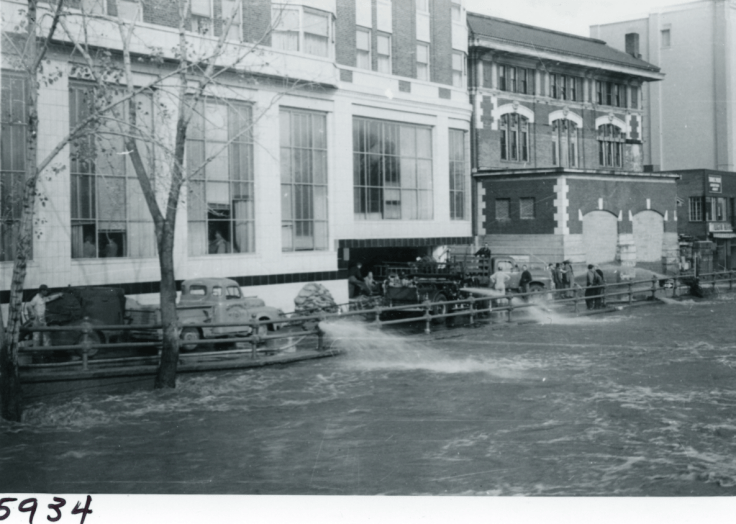
The Truckee River flooded in November of 1950, sending waves down First Street.
[WA-04095], [Photographs], Nevada Historical Society
Water rose above the lockers in the YMCA basement with pressure pushing it up through the floor.
[MSNC01100_4_7_001], [Photographs], Nevada Historical Society
This photo of workers pumping water from the neighboring Mapes Hotel shows the rear addition windows had been infilled and the walls of the roof garden had been removed. The high-water mark was impressive.
[WA-05934], [Photographs], Nevada Historical Society
In January of 1953, a proposal by siblings Charles and Gloria Mapes was announced to purchase the YMCA building and vacate the south end of Lincoln Alley to allow for expansion of their hotel.
Gazette, January 13, 1953.
At around 11:30 a.m. on February 7, 1953, the YMCA was hopping. A swim class was in progress in the basement. 15 boys were playing basketball in the gym.
[MSNC01100_5_6_001], [Photographs], Nevada Historical Society
The boiler, which had undergone welding repairs the day before, exploded causing the heating chamber to blast through an 18-inch brick wall under the gym. The brick walls of the gym were pushed out and the floor pushed up, launching Vinton Goure into the air and breaking his femur. The two other boys injured and taken for treatment were Roy Clayton and Bob Gordon.
Fortunately, no one was in the adjacent shower room, which was destroyed.
[MSNC01100_4_2_005], [Photographs], Nevada Historical Society
The boxing ring is shown here with a couple turnbuckles still standing.
[MSNC01100_4_2_003], [Photographs], Nevada Historical Society
A heavy bag was left hanging on the left in a room full of debris.
[MSNC01100_4_2_004], [Photographs], Nevada Historical Society
A water line broke in the explosion causing a 50-pound drum of chlorine crystals to get wet. This filled the basement with dangerous fumes and it’s a miracle no one was killed. The structure was immediately condemned and utilities were disconnected. However, staff continued using the front offices without services while the organization sought temporary quarters.
YMCA staff moved to the Hobson building at Center and State on March 31, 1953. The condemned building was sold to the Mapes Hotel for approximately $150,000 minus insurance claims collected. Demolition began on May 19.
Nevada State Journal, May 21, 1953, 8. Newspapers.com.
Building materials, furniture, and fixtures were salvaged from the building and offered for sale.
Nevada State Journal, July 7, 1953, 9. Newspapers.com.
After the lot was cleared and the alley was vacated, the former YMCA property was used as a parking lot. The planned Mapes Hotel annex never materialized.
[MSNC01100_4_2_001], [Photographs], Nevada Historical Society
An open house event was held at the new Reno YMCA on Foster Drive in May of 1956. The Mapes Hotel closed in 1982 and was imploded on January 30, 2000. The site, including the former YMCA lot, is now home to City Plaza, often called Believe Plaza.
This is how the former site of the Reno YMCA looks today:
Photo by Anna King
It seems fitting that a property which was donated to serve the public for more than 40 years has been returned to that use. City Plaza is now the main gathering space in Reno for protests, vigils, and community celebrations.
If you like what you see, be sure to subscribe (way at the bottom of the post on mobile devices) to receive an email each time a new post is published and share on social media. You can also support my work by donating below. This content is 100% funded by history fanatics such as yourself. Thanks for reading!
Donation
Your support keeps the content flowing! Make a one-time donation. Your contribution is appreciated!
In Dodge City’s earliest days, what became Chestnut Street was just an alley behind the Front Street buildings. Business was conducted within close proximity to the Santa Fe depot so the block between Second and Third Avenues took a while to fill with structures. Aside from the post office at the northwest corner of Second and Front, that block held a saddle and harness shop, a blacksmith shop, and a dance hall.
One of the challenges with documenting establishments is attempting to decipher what people meant when they used descriptions like “One Door West of the Post Office.”
Ford County Globe, April 30, 1878, 3. Newspapers.com.
Typos happen and also how many empty lots were located between the doors?
Ford County Globe, May 14, 1878, 4. Newspapers.com.
Buildings came and went and so did the businesses.
Ford County Globe, January 20, 1880, 1. Newspapers.com.
Without being too precious, I can tell you Jacob and Jennie Collar ended up owning lots 46 and 48 west of the first post office. They owned several lots on Front Street and leased the buildings to a variety of businesses.
Ford County Globe, February 19, 1884, 2. Newspapers.com.
In March of 1884, brothers James and William Keady and Bro opened a grocery and produce business one door west of the post office.
Ford County Globe, April 8, 1884, 5. Newspapers.com.
That October, the grocery temporarily relocated and the Collars replaced the small wood structure with a single-story brick building with two spacious storefronts and a tiny one between them.
The Dodge City Times, October 30, 1884, 4. Newspapers.com.
After the Keadys moved to the new brick, Joseph Felkel used a corner of the space for his shoe shop. Adolphus Gluck also used part of the building for his jewelry store. I won’t bore you with the musical chairs which transpired from then until Jacob Collar’s death in March of 1893. Jennie retained ownership of the brick building, which she leased to a barber, a grocer, and a furniture dealer.
After Jennie Collar died in January of 1899, her sister, Fannie Goodman, inherited the property. Adolphus Gluck was chosen to administer the estate and it took him a few years to dispose of the various properties. As this was taking place, William A Sturgeon bought the Keady grocery store in October of 1902 and it became known as Sturgeon’s Cash Grocery.
The Globe-Republican, November 6, 1902, 8. Newspapers.com.
The following spring, William and his father, Frank, bought the building from Fannie Goodman for $3,000. Other tenants at that time were the C. H. Gingrich cigar factory and the C. L. Peterson tailoring business. The north ends of the lots along Chestnut were empty.
The Globe-Republican, April 16, 1903, 1. Newspapers.com.
Frank Sturgeon intended to construct a two-story brick building along Chestnut and then add another story to the Front Street side but he died in November of 1904 at only 58 years of age. In June of 1906, William Sturgeon sold the grocery to brothers Roy and Ralph Burnett.
The Globe-Republican, June 14, 1906, 10. Newspapers.com.
J. F. Ayers moved his Central Meat Market to the space west of the Burnett grocery in the Spring of 1912.
The Dodge City Globe, March 7, 1912, 5. Newspapers.com.
Ralph Burnett bought his brother’s share of the business in January of 1913. The building is shown here west of City Hardware with the Chestnut Street portion still empty.
Postcard: Ford County Historical Society Troy Robinson Collection
Around that time, the skinny middle space was occupied by the general repair shop of John E Reynolds.
The Dodge City Daily Globe, March 10, 1915, 3. Newspapers.com.
Hiram A Burnett, President of the National Bank of Commerce, began construction to fill in the space between his son’s grocery and Chestnut Street in the Spring of 1915. This would allow Ralph to expand his store and have additional space to lease in the west half of the building. Initially planned as a single-story extension, Burnett saw improvements the Nevins family was making to their new hardware store next door to the west and decided to match them. Main entrances would be on Chestnut but the Front Street doors would be retained. The Front Street section also remained a single-story structure.
The Dodge City Daily Globe, April 16, 1915, 1. Newspapers.com.
Newt and Martha Nevins opened their Dodge City location of Nevins Hardware Company at 309 Chestnut on April 30, 1915 with hundreds in attendance. Initially, son Clarence managed the store in Ford, while Ralph and Arthur worked at the Dodge City store with their dad. Daughter Eulalia was the county education superintendent by that time but she was never far from the store, eventually serving as secretary and treasurer. Clarence came to Dodge about a year later to become the general manager of the Nevins Hardware and Implement Company.
The Dodge City Globe, April 22, 1915, 8. Newspapers.com.
Ralph Burnett held a grand opening at his expanded store on July 31, 1915.
The Dodge City Globe, July 29, 1915, 5. Newspapers.com.
Happy Jack BeDillion then opened his Popular Cafe in the west half on August 8. The move to larger quarters allowed space for confectionery and ice cream departments as well as a cigar section.
Dodge City Daily Globe, August 7, 1915, 4. Newspapers.com.
The Burnett grocery and Popular Cafe used similar typefaces in their clerestory signage on the right.
Postcard: Ford County Historical Society
The original Burnett space on Front Street was remodeled and occupied by Dodge City Plumbing Co. in the fall of 1916.
Dodge City Daily Journal, November 22, 1916, 3. Newspapers.com.
That December, brothers Leo and Wilbur Liggett bought the Burnett grocery.
Dodge City Daily Journal, December 29, 1916, 3. Newspapers.com.
At that time, John McChristy operated a grocery at 306 Front. Brothers Harry and Jesse Holmes bought the Popular Cafe and moved it a couple blocks east in February of 1919. Flora Burgland then used the former cafe for her millinery store.
Dodge City Daily Globe, October 20, 1919, 2. Kansas Heritage Center.
The Nevins Hardware Company needed additional storage space and bought the Burnett building in September of 1920 for around $30,000. At that time, the tenants were allowed to stay. This postcard with a postmark of March 29, 1923 shows the Liggett’s and Burgland signage at far right.
Postcard: Ford County Historical Society Pat Anders Collection
The Burgland millinery store became the Sturgeon Hat Shop around the Spring of 1926.
The Southwest News, April 1, 1926, 5. Newspapers.com.
The plumbing shop became the Cozy Cafe.
Dodge City Daily Globe, December 23, 1927, 4. Kansas Heritage Center.
Tasker Book and Stationery Shop temporarily used the west space on Chestnut in the latter part of 1928.
Dodge City Daily Globe, September 22, 1928, 45. Kansas Heritage Center.
Big changes were made around 1929. Suddenly, the Front Street side was a proper two-story building.
Photo: Ford County Historical Society Sam Zygner Collection
After an extensive remodeling project, what was then called Skaggs Safeway held a grand opening on October 18, 1929.
The Dodge City Journal, October 17, 1929, 4. Newspapers.com.
The Safeway store is shown here during the parade celebrating the premiere of Dodge City on April 1, 1939.
Photo: Kansas Heritage Center
Safeway closed around 1940 and Nevins Hardware moved next door into the much larger space. By this time, the implement and hardware businesses had split with Arthur taking on the implement side and Ralph operating the hardware store.
Nevins Hardware is shown here during the 1950s with Fowler Furniture in their former location to the west.
Photo: Kansas Heritage Center
This is the view looking east.
Photo by Hoover Cott, Ford County Historical Society Troy Robinson Collection
I know I’ve seen a photo of the full Nevins Hardware sign painted on the east wall of the Front Street side but of course, I can’t find it when I need it.
Photo by Hoover Cott, Ford County Historical Society Troy Robinson Collection
UPDATE: Found it! Just a few days late.
Dodge City Daily Globe, Kansas Centennial Special Edition, July 1961. Author’s collection.
The Eckles family bought the store in February of 1963 and it was renamed Eckles Hardware. This photo was taken when Fowler Furniture caught fire in 1964.
Photo by Art Morenus, Ford County Historical Society Troy Robinson Collection
It operated until at least 1967 but the entire block was doomed by the infamous Urban Renewal project. Not everything went to waste, however. Building materials and fixtures were salvaged and sold. In his book, Dragging Wyatt Earp: A Personal History of Dodge City, Robert Rebein tells the story of his father buying the glass door from Nevins Hardware and using it as the back door of their home at 1211 W Cedar Street. By 1970, all of Front Street had been completely erased.
Here’s a full view of the old hardware signs with Nevins painted over just prior to demolition.
Photo by Joleen Fromm
Photo by Joleen Fromm
This is how the former site of Nevins Hardware looks today:
Photo by Jan Shaw
Rather than repeatedly harping on the negative effects of Urban Renewal, I feel I should acknowledge the extent to which I torment the fine folks at the Kansas Heritage Center with my exhaustive inquiries. Thanks for all of your help!
If you like what you see, be sure to subscribe (way at the bottom of the post on mobile devices) to receive an email each time a new post is published and share on social media. You can also support my work by donating below. This content is 100% funded by history fanatics such as yourself. Thanks for reading!
Donation
Your support keeps the content flowing! Make a one-time donation. Your contribution is appreciated!
Stockman Levi W Lee and his wife, Julia, owned a ranch north of Reno on the Susanville state road. They moved to Reno around 1874 where Levi acted as superintendent of the fairgrounds and served on the board of Reno Water Company.
The Lees purchased the west half of the block on the east side of Sierra between Fourth and Fifth Streets. In June of 1876, construction began on a two-story livery stable with hay storage and living quarters on the second level. The first floor was constructed of stone with brick above. A large wooden balcony wrapped around the south and west sides of the building.
Daily Nevada State Journal, June 11, 1876, 3. Newspapers.com.
The facility opened for business that September.
Reno Evening Gazette, September 30, 1876, 3. Newspapers.com.
Lee served both the traveling public and the stock trade so he installed a Fairbanks scale in May of 1877.
Reno Evening Gazette, May 19, 1877, 2. Newspapers.com.
A new harness shop opened at Lee’s in March of 1878. Continuous improvements were made to the yard with a series of corrals and frame stables occupying the large parcel.
Levi Lee suffered a stroke in the early morning of March 26, 1886 and died five days later at the age of 52.
Reno Evening Gazette, April 1, 1886, 3. Newspapers.com.
Levi and Julia’s three school-aged sons, Frank, Eugene, and Ben, chipped in to help keep the stable running while a buyer was sought. Partners Andrew Benson and Frank Engstrom bought the entire operation for around $20,000 in July of 1886.
Reno Evening Gazette, July 22, 1886, 2. Newspapers.com.
The name of the business was changed to Eureka Stables shortly after the purchase. Benson continued the operation as a sole proprietor after his partnership with Engstrom was dissolved in June of 1887.
Reno Evening Gazette, June 10, 1887, 1. Newspapers.com.
After his Depot Hotel burned, Robert W Parry purchased the Eureka in August of 1889.
Daily Nevada State Journal, August 27, 1889, 2. Newspapers.com.
The stone and brick stable is depicted here in an illustration from around 1898. This would be looking northeast from Fourth and Sierra.
Powning, C. C., and H.S. Crocker & Co. Birds Eye View of Reno, Nevada. C.C. Powning, n.d.
By April of 1899, wood structures and fencing lined most of the alley behind the stable. The largest was a two-story barn measuring approximately 40 by 125 feet. The main floor contained several horse stalls with hay storage above.
That barn went up in flames on November 12, 1899. A bucket brigade saved the home across the alley, which only received damage to a porch roof. “Drunken Indians” were blamed for the blaze. In this photo showing the aftermath of the fire, the building with the arched windows appears to be the First Congregational Church at Fifth and Virginia.
[WA-03004], [Photographs], Nevada Historical Society
Parry decided to replace the wood barn with a new brick structure connected to the east end of the main stable building with frontage on Fourth Street. This addition would be taller so the roof on the corner building would be raised to match the new height of approximately 52 feet. This would make the main stable building two and a half stories tall. The combined structures measured about 140 by 90 feet.
Nevada State Journal, February 8, 1959, 6. Newspapers.com.
In February of 1907, Parry announced his intention to transform the entire building into a theater. He wanted to reconfigure the property so the entrance to the stockyards was on Fifth Street. Instead, the east addition became a “strictly fireproof” skating rink.
Reno Evening Gazette, August 28, 1907, 5. Newspapers.com.
Reno Amusement Company’s Aetna Rink opened to the public on November 27, 1907 complete with a 14,000 square foot maple floor. Music came from a German orchestrion machine.
Reno Evening Gazette, November 27, 1907, 5. Newspapers.com.
The rink’s fireproof claims were disproven when the building went up in flames on July 25, 1909. Parry’s neighboring stable building, by that time used as a warehouse for Studebaker wagons and buggies, was also engulfed. People sleeping upstairs barely escaped.
Nevada State Journal, July 26, 1909, 1. Newspapers.com.
Parry prepared to rebuild once again but this time, with the upper floors removed.
Reno Evening Gazette, October 8, 1909, 2. Newspapers.com.
Brothers Frank and Otto Steinheimer had recently acquired the Studebaker agency and they would occupy the corner space. The Steinheimers also sold coal from this location.
Nevada State Journal, December 5, 1909, 5. Newspapers.com.
The east half of the building was occupied by the Central Auto and Machine Works garage.
Reno Evening Gazette, October 8, 1910, 8. Newspapers.com.
Central Auto moved to Fifth and Sierra at the end of 1914 and their previous spot became occupied by Reo Sales Company.
Reno Evening Gazette, November 30, 1914, 3. Newspapers.com.
This establishment was also known as the Lincoln Garage.
Reno Evening Gazette, March 13, 1915, 10. Newspapers.com.
On January 15, 1921, Frank Steinheimer announced he had purchased the Lincoln Garage. This circa-1921 photo shows the two Steinheimer businesses.
[WA-01673], [Photographs], Nevada Historical Society
Lincoln Garage was advertised for lease in January of 1934 and the business itself was sold the following year. The garage relocated across the street and its former space was leased to Nevada-California Fast Freight Line, which became Pacific Intermountain Express. They vacated the building in 1940 and it was again used as an auto repair shop by C. C. Hooley and George Russell.
The Steinheimer brothers retired in 1942 but retained ownership of the buildings.
Nevada State Journal, April 21, 1942, 12. Newspapers.com.
B. F. Goodrich moved to the Steinheimer building in November of 1943.
Nevada State Journal, November 21, 1943, 18. Newspapers.com.
At that time, the east building was used by the Wesley J Gritton Studebaker dealership, which became Nevada Car Co. in 1950.
Nevada State Journal, January 6, 1950, 12. Newspapers.com.
In December of 1956, the dealership became Seevers Studebaker and Packard owned by Farrell L Seevers. Reno Transmission Exchange occupied that space by January of 1961. That March, Goodrich announced the store would be moving to a new location on East Fourth.
The former Goodrich store is shown here in April of 1961.
[WA-07039], [Photographs], Nevada Historical Society
By 1963, the corner building hosted Allied Automotive’s paint shop. Around 1965, Allied had the entire complex with half being used as a warehouse. Sadie Steinheimer, Otto’s widow, died in June of 1968 and the family decided to sell the property. It was purchased by James Daniels, who owned part-interest in the Daniels Motor Inn. The former Steinheimer building was demolished that fall for a parking lot.
Nevada State Journal, October 20, 1969, 16. Newspapers.com.
U Park & Lock became somewhat notorious as a hangout for the criminal element. Local business owners reportedly thanked Don Carano after his May 1993 announcement that the parking lot would be replaced by a hotel casino.
Project C was a joint venture of Eldorado Hotel Casino and Circus Circus Enterprises. The original plan called for a huge facility with a 16th-century Spanish “theme resort” and 2,000 rooms. Ground was broken in early 1994 but that June, the group pivoted to a plan which would honor the history of the Comstock Lode in the form of a fictitious character called Sam Fairchild.
That November, word got out that Project C would be called Silver Legacy when state Senator Bill Raggio accidentally let it slip. The named project was finally unveiled that December complete with a 120-foot mining derrick distributing “minted” coins on the gaming floor. The derrick would be inside a dome measuring 180 feet in diameter. The main building was designed with false storefronts in the style of a Victorian-era mining town. A large events center was planned for the basement.
Photo by David B Parker, Reno Gazette-Journal, December 16, 1994, 23. Newspapers.com.
Wide pedestrian bridges with shops, eateries, and even a microbrewery would connect the Silver Legacy with the Eldorado and Circus Circus. The plan included three hotel towers (37, 34, and 31 stories) with around 1,720 rooms. Due to the redesign, the Silver Legacy was projected to cost about $310 million.
The steel structure was completed by the end of 1994 followed by the dome in March of 1995. That June, a four-inch natural gas line was ruptured and the dome was filled with gas. Businesses nearby were evacuated and more than 60 people were treated for exposure at area hospitals.
Many locals were displeased with the new addition to Reno’s skyline. It was suggested that the dome’s appearance could be improved by painting it. That didn’t happen. Others countered that it was across the street from a giant striped circus tent. Like, how offended could you realistically be?
Reno Gazette-Journal, June 17, 1995, 122. Newspapers.com.
But for a casino with false exterior storefronts designed to mimic an old west mining town, complete with a sign saying it was established in 1895, why was it designed with a giant modern dome on top? In my opinion, that’s a swing and a miss.
Reno Gazette-Journal, July 27, 1995, 46. Newspapers.com.
Silver Legacy opened on July 28, 1995 to a packed house. The evening was capped off with a fireworks show. The hotel reportedly sold out its first 22 nights, although at slightly less than full capacity of 1,284 completed rooms. Early versions of the Silver Legacy website can be found on the Wayback Machine.
Silver Legacy filed for Chapter 11 bankruptcy in the spring of 2012 in an attempt to restructure around $142 million worth of debt. The company reportedly took out a mortgage in 2002 at TEN PERCENT interest. The facility was remodeled in 2021 for around $47 million and currently lists 42 floors with more than 1,700 rooms. In addition to the huge gaming floor, there are also five restaurants and six bars and lounges. It is currently owned by Caesars Entertainment.
Normally, I try to photograph every site I write about from an angle matching a historical image but between the weather and me not wanting to take pics of another casino, I just didn’t.
Here are a couple shots of the giant boob from earlier this year.
Photo by Anna King
Photo by Anna King
I am also including an interior walking tour found on YouTube.
I find the decision not to paint the giant boob disappointing. Reader, I know it’s all about that money. But don’t you ever get tired of old buildings being replaced by soulless casinos?
If you like what you see, be sure to subscribe (way at the bottom of the post on mobile devices) to receive an email each time a new post is published and share on social media. You can also support my work by donating below. This content is 100% funded by history fanatics such as yourself. Thanks for reading!
Donation
Your support keeps the content flowing! Make a one-time donation. Your contribution is appreciated!
Brothers Glen and Roy Flint of Englewood bought Dodge City’s Hudson-Essex dealership from James P McCollom in January of 1926. As part of the sale, the Flints were able to use space in McCollom’s Santa Fe Trail Garage at the southwest corner of Second and Spruce until they could find a permanent location.
Dodge City Daily Globe, January 1, 1926, 1. Kansas Heritage Center.
Glen moved to Dodge along with his wife, Veronica, and managed operations, while Roy remained in Englewood. That April, plans were announced for a new building on Second Avenue between the new Odd Fellows Hall and the Elks Home. Julian Parham was awarded the contract to build a two-story brick and concrete structure with a full basement. Flint Motor Co. would use the main floor for automobile sales and the machine shop, managed by racecar driver Chick Logan, would be located in the basement. Access to the shop would be through a door facing the alley. The second floor was expected to be divided into office spaces.
This circa-1927 photo shows the Flint Motor Co. building with loads of glass along the front. The cars parked out front belonged to the Gum Motor Co. next door.
Photo: Kansas Heritage Center
Flint Motor Co. began occupying their new quarters in October of 1926. At that time, the second floor hadn’t been finished.
Dodge City Daily Globe, November 13, 1926, 8. Kansas Heritage Center.
The company began selling International trucks in 1929.
The Dodge City Journal, June 27, 1929, 2. Newspapers.com.
Around that time, Loyal Order of Moose Dodge City Lodge No. 1187 began occupying the second floor. Flint moved south of the tracks on Second Avenue in the early 1930s and Dodge City Parts Company moved to their former space.
The Montezuma Press, June 28, 1934, 5. Newspapers.com.
That business ultimately became part of Scheufler Supply Co., which moved to West Trail Street in 1937. At that time, Kansas Power Company was expanding and began using the building for offices. By the early 1940s, the power company shared the building with the Western Investment Co. and the H. F. Krey Agency. This insurance and real estate firm became Krey and McCook Agency.
1947 City Directory and Business Professional Guide for Dodge City, Kansas. Published by Southwest Directory Company.
This photo from 1950 shows all of the glass along the front still intact. The door where the cars had been driven though had been converted to a store front entrance under the Moose sign.
Kansas Power Company became Western Light and Telephone Co. Its business office interior is shown here in June of 1952.
Photo: Kansas Heritage Center
Krey and McCook moved to the other side of the street in the early 1950s and the Moose Lodge relocated to Minneola Road. New building occupants included accountant Morton Fisher and Russell Realty Co.
All of the glass is still intact in this image from the 1956 Boot Hill Fiesta Parade.
Photo: Ford County Historical Society Studio de Lari Collection
By 1957, the large upper windows had been replaced by glass blocks with tiny window inserts.
Photo: Ford County Historical Society Studio de Lari Collection
That sign was a real treasure.
Photo: Ford County Historical Society Studio de Lari Collection
Western Light and Telephone became Western Power and Gas in 1965. In 1968, the south storefront became vacant, followed by the rest of the building. Around 1972, Western Power began using the building for their accounting center. I believe the main floor storefronts were removed and replaced with marble infill around that time. For some reason, they chose white for the north and pink for the south.
By the early 1980s, data entry functions were also performed in this facility, which became known as Centel Electric.
Dodge City Daily Globe, February 22, 1990, 43. Kansas Heritage Center.
Ownership changed again to WestPlains Energy in the 1990s. After that, the building was used as an annex by the Dodge City Daily Globe. Since a doorway connects the two structures on the second floor, it was easy for dance classes to be held on either side by various studios located next door.
The Globe began the slow process of vacating the property in 2021 and it was sold to an out-of-state investor. It’s been for sale and for lease pretty much ever since but hasn’t, to the best of my knowledge, ever been improved. Facebook listings show an outdated, stained, and generally grim environment which could be the location for a Backrooms sequel. See for yourself:
Here are some photos I have taken over the past several years. Note the WestPlains Energy ghost sign on the back door.
Photo by Anna King
Photo by Anna King
Photo by Anna King
Photo by Anna King
Photo by Anna King
Photo by Anna King
I was asked to write about this building more than a year ago and just haven’t had it in me. It’s sturdy and has great potential but my God, it’s had every ounce of light stripped from it. Good luck, I guess.
If you like what you see, be sure to subscribe (way at the bottom of the post on mobile devices) to receive an email each time a new post is published and share on social media. You can also support my work by donating below. This content is 100% funded by history fanatics such as yourself. Thanks for reading!
Donation
Your support keeps the content flowing! Make a one-time donation. Your contribution is appreciated!
Radio came to Reno in fits and starts. The University of Nevada’s School of Electrical Engineering attempted to get their own station going during the 1921-22 school year.
Artemisia, 1922, 38. Published by the Associated Students of the University of Nevada.
Call letters KOJ were assigned in the Spring of 1922.
The Kansas City Star, May 10, 1922, 10. Newspapers.com.
But the school wasn’t actually ready to proceed and by that July, the university no longer had a license. Later that year, there were KDZK (Nevada Machinery and Electric Company) at the Majestic Theatre and KFAS (Hadley S Beedle and Dr. D. H. Cordano). KFFR was at Sparks High School in 1923 but there was no local radio in Reno by 1924. In the Spring of 1928, listeners relied on regional stations as far away as Denver.
Nevada State Journal, May 25, 1928, 4. Newspapers.com.
That July, the local broadcasting question was posed to readers.
Nevada State Journal, July 9, 1928, 4. Newspapers.com.
Enter mobile broadcaster, Jay Peters. In the Spring of 1928, the Albuquerque Journal reported Peters’ portable station KGGM would be broadcasting during the C. C. Pyle cross-country marathon in a Graham school bus. The Federal Radio Commission banned portable stations that summer so Peters made arrangements to set up a permanent location in Albuquerque. KGGM began broadcasting from the mezzanine of the Franciscan Hotel that August.
Albuquerque Journal, May 6, 1928, 18. Newspapers.com.
Leaving W. E. Whitmore and A. R. Riedling to operate the station in Albuquerque, Jay Peters made his way to Reno.
Reno Evening Gazette, July 11, 1928, 6. Newspapers.com.
Space was leased by the newly formed Jay Peters, Inc. in the basement of the Elks’ Home at 50 N Sierra Street.
Elks’ Home, Reno, Nevada, published by Edward H. Mitchell, ca. 1907-1912. The Bancroft Library Walter Robert and Gail Lynn Kransky collection of Edward H. Mitchell postcards.
Broadcast station KOH was granted a construction permit in September of 1928.
Radio Service Bulletin No. 138, September 29, 1928, 3. Department of Commerce Radio Division.
A transmitter was installed at Blanchfield Field southwest of Plumas Street and Urban Road.
[Reno Airport, UNRS-P1010-3.tif], Special Collections and University Archives Department, University of Nevada, Reno.
To operate a radio station, one needs programming. Prior to securing network affiliation, KOH was on its own and began appealing to the community for talent.
Reno Evening Gazette, October 25, 1928, 5. Newspapers.com.
The first official KOH broadcast was scheduled for November 11, 1928, which was Armistice Day.
Nevada State Journal, October 26, 1928, 8. Newspapers.com.
However, the station needed to make sure everything worked properly so test broadcasts were conducted followed by a singing competition on October 30.
Reno Evening Gazette, October 29, 1928, 8. Newspapers.com.
Everything went so well, KOH was able to broadcast election returns live from the Gazette offices. Church services were broadcast on the fourth Sunday of each month. Listeners could also set their watches to the radio, as KOH gave the correct time each hour.
There’s a lot going on in this photo from April of 1929. I haven’t been able to locate the name of the announcer but he had bottles of whiskey and sparkling wine stashed on top of the equipment in the basement window.
[KOH radio station, Reno, interior UNRS-P1992-01-2086.tif, collection_4374], Special Collections and University Archives Department, University of Nevada, Reno.
The Elks Home was demolished after the gas explosions at First and Sierra on February 5, 1957. The site is currently occupied by The Palladio apartments and retail shops. Here’s how it looks today:
Photo by Anna King
Peters leased a third of the Otto Steinheimer building at 440 N Virginia in the Summer of 1930.
Reno Evening Gazette, June 7, 1930, 7. Newspapers.com.
This allowed the station to remove the transmitter from the old municipal airport (Blanchfield Field) and install two new 100-foot towers on the building. KOH moved to its new location that October.
Reno Evening Gazette, October 4, 1930, 12. Newspapers.com.
The former site of the airport, which was known by several names, is now the Washoe County Golf Course and Reno Tennis Center. A marker on Plumas Street commemorates the site.
Photo by Anna King
Photo by Anna King
Peters sold KOH to the McClatchy Company in February of 1931, right after becoming a CBS affiliate. Joy True became the station’s general manager at that time and was also responsible for the Bee Engraving Company, which was part of the Sacramento Bee.
Reno Evening Gazette, February 18, 1931, 14. Newspapers.com.
Former Reno resident and heavyweight boxing champion Jack Dempsey is pictured at the KOH microphone, possibly prior to a fight at Race Track Arena in 1931.
[Jack Dempsey UNRS-P1998-15-298.tif, collection_3643], Special Collections and University Archives Department, University of Nevada, Reno.
True resigned as general manager when she remarried in July of 1937. Her replacement was Wallie Warren.
[Cobb-KOH-005], [Photographs], Neal Cobb Collection, Nevada Historical Society
In September of 1939, McClatchy announced plans to build a new transmitter on a 20-acre site northeast of what is now Sparks Boulevard and E Prater Way. Their FCC application requested a power increase from 500 to 1,000 watts and a frequency change from 1380 to 630 kilocycles. After initially being denied, the application was finally approved that December. A new studio building projected to cost $20,000 was also in the works, as was a change from CBS to NBC effective January 1, 1940.
The former KOH studio at 440 N Virginia Street is shown here in the 1980s.
[WA-06795], [Photographs], Nevada Historical Society
This is the building as of May 2026:
Photo by Anna King
The new KOH studio building was constructed at 143 Stevenson Street. This air-conditioned facility included two studios, a control room, and staff offices. Members of the public were invited to inspect the new building, which opened August 23, 1940.
Reno Evening Gazette, August 22, 1940, 3. Newspapers.com.
Announcer and technician Bryan Wright, who had joined KOH in 1937, is shown here in the Stevenson studio.
[Cobb-ManStreet-015], [Photographs], Neal Cobb Collection, Nevada Historical Society
Chief transmitter engineer Tom Boland, shown here cueing up a record, left Reno to become an experimental engineer with Boston’s Submarine Signal Co. in October of 1944.
[Cobb-ManStreet-018], [Photographs], Neal Cobb Collection, Nevada Historical Society
Merrill Inch was hired to manage KOH in November of 1947.
[Cobb-KOH-026], [Photographs], Neal Cobb Collection, Nevada Historical Society
In the Spring of 1964, KOH obtained a variance from Washoe County to build a new studio and office space at the transmission site on E Prater Way. The transmitter building was also expanded as part of that project. The old facility on Stevenson was vacated by the Spring of 1965 and later housed the Nevada Thrift Shop. It was demolished in the 1970s to make way for a new Greyhound bus station. That building was also demolished in late 2018 to early 2019. It is now an empty lot.
Photo by Anna King
KOH, which had broadcast all sorts of entertainment since 1928, switched to an all-news format in 1975. They did continue with sports broadcasts, however.
Reno Evening Gazette, June 29, 1965, 11. Newspapers.com.
In February of 1982, a public hearing was scheduled to discuss McClatchy’s plans to develop the 20 acres so that about half would be office buildings surrounding the studio and the other half would be a mix of townhomes and shopping. This would require the two towers to be moved. The name for the project would be McClatchy Corner. In October of that year, McClatchy sold KOH in a confusing move which can only be explained by FCC rules. Sierra-Pacific, Price, Klein…you get the idea.
Nevada State Journal, October 27, 1982, 36. Newspapers.com.
So McClatchy Corner wasn’t really a thing but the development did eventually materialize with the studio and transmitter towers both being relocated. Olympic Broadcasters, Inc. acquired the station in the Summer of 1990. KOH began operating in an office park on Delucchi Lane.
Olympic sold the KOH call letters and programming to Citadel Communications, Inc. in the Spring of 1994 but not the station itself. Space was acquired at 595 E Plumb Lane for this new operation. As part of the deal, Citadel wanted to increase its power to 50,000 watts and that meant losing the familiar three-letter call. The new KKOH moved to 780 on the dial but has continued being advertised as KOH.
Citadel Broadcasting Corporation was reorganized as Citadel Broadcasting Company in 2010 and it then merged with Cumulus Media, Inc. An application to transfer the KKOH license was submitted in the Spring of 2011.
Reno Gazette-Journal, April 15, 2011, 24. Newspapers.com.
Terrestrial radio was a vital part of everyday life for the majority of the twentieth century. The stations hanging in there today have adapted to the digital age while keeping on-air personalities who are connected to their communities. KOH seems to have found its niche in the talk format and is going strong after nearly 100 years.
If you like what you see, be sure to subscribe (way at the bottom of the post on mobile devices) to receive an email each time a new post is published and share on social media. You can also support my work by donating below. This content is 100% funded by history fanatics such as yourself. Thanks for reading!
Donation
Your support keeps the content flowing! Make a one-time donation. Your contribution is appreciated!
Dodge Citians have always needed a place to congregate. In the early 1870s, important meetings were often held in saloons, from which women were excluded. As the town became more civilized, facilities like Kelley’s Opera House, McCarty’s Skating Rink, and the Chalk Beeson Theater filled that role. But those were private businesses and our churches were initially too small. It became clear Dodge needed public spaces.
After George Hoover’s death in July of 1914, funds received from his estate were earmarked for a new municipal auditorium. Contracts were finally let for construction of the Hoover Pavilion in February of 1919. But that building was also small and the sides were open to the elements, making year-round use impractical.
We needed something bigger and the City Commission thought maybe the Works Progress Administration (later Works Projects Administration) could help as part of the New Deal. However, voters were asked to approve $40,000 in additional bonds for a new auditorium in September of 1936, with the bulk of a $125,000 auditorium being funded by the WPA. The Great Depression wasn’t the time for more debt.
Voters decided the time for more debt was during the post-World War II building boom. A $400,000 bond issue passed by a wide margin in June of 1945.
Dodge City Daily Globe, June 13, 1945, 1. Kansas Heritage Center.
It was really happening, until it wasn’t. Somehow, the City held this special election before selecting a site. Construction materials were in short supply due to the postwar euphoria. Prices rose pretty dramatically and auditorium plans were put on the shelf.
Another $385,000 bond issue passed in September of 1952 and this time, they meant it.
The Leavenworth Times, October 1, 1952, 8. Newspapers.com.
But once again, they had to argue over a location. A site was selected “at the end of First Avenue” and some people thought that was crazy. It was in the middle of nowhere! This aerial photo was taken in September of 1953. You can see the area just northwest of the water tower was pretty empty.
Photo: Ford County Historical Society Studio de Lari Collection. Annotated by Anna King.
A. R. Mann and Company dusted off their original plans and made revisions to fit the current budget. The building measured 235 x 240 feet with a curved façade and would seat 2,764 for basketball games. Stage events could accommodate 3,272. The facility also included five meeting rooms.
Polk’s Dodge City (Ford County, Kansas) Directory 1957, XII.
In March of 1954, Hunter Construction Co. of Hays was finally awarded the general contract in the amount of $420,800. Construction began on April 19. That September, changes were approved to add an office facing the lobby and changes to the wiring for the stage, switchboard, and press box.
The back side of the building is shown here during construction looking north. The parking lot would have space for 1,000 cars.
Photo: Ford County Historical Society Troy Robinson Collection
Former Mayor Gordon Morgan, City Commissioner Dale McCook, and former Mayor Charles Clinton were photographed in front of the entrance on September 12, 1955.
Photo: Ford County Historical Society Studio de Lari Collection
The cost of construction was $763,630 but some extra funds were needed to purchase additional equipment. You can see the building originally had a row of windows just below the ceiling of the auditorium. That seems like a poor choice in a west-facing building. In addition to the horrible glare, those upper seats must have been toasty in the summer.
Photos: Ford County Historical Society Studio de Lari Collection
A two-day formal opening was held October 8-9, 1955. This program contains a glaring typo; The auditorium was not, in fact, completed in under three months.
Program: Kansas Heritage Center
Governor Fred Hall of Dodge City spoke at the dedication ceremony on October 9.
The Evening Eagle, (Wichita, Kansas) October 10, 1955, 11. Newspapers.com.
The Municipal Auditorium became known as the Civic Center in the early 1970s. You can see those upper windows had already been bricked in by the time this photo was taken.
Photo: Ford County Historical Society Dodge City Daily Globe Collection
I should note that the curtain has been swapped out and a large portion of the original resides at the Ford County Legacy Center.
1975 Sou’Wester, Dodge City, Ks. Senior High.
For many years, the Civic Center hosted the Southwest Kansas Square Dance Festival.
Photo: Ford County Historical Society Troy Robinson Collection
I learned to hate circuses and love Russian Ballet at the Civic Center and I also sat in the student section on the stage at Demon basketball games. Here’s L. J. Goolsby doing his thing in the early 1990s.
Photo: Ford County Historical Society Dodge City Daily Globe Collection
High school graduation ceremonies were held at the Civic Center for ages. We’ve attended concerts, voted, and learned about upcoming changes to our community in that building.
Speaking of learning, the City Commission and USD 443 approved a plan to transfer ownership of the Civic Center property to the school district in January of 2013. The Board of Education discussed options for a new administration building in September of 2017. This new facility would be tacked on to the north end of the Civic Center and designed with an exterior aesthetic very similar to its mid-century neighbor. The administration building opened in July of 2020 but no grand opening was held at that time due to COVID-19. Public tours were finally given in December of 2021 with the return of the Cowboy Capital Classic at the Civic Center.
This is how the former Municipal Auditorium looks today:
Photo by Jan Shaw
Photo by Jan Shaw
Photo by Jan Shaw
Coincidentally, Josh Roesener recently broadcast live from the Civic Center welcoming kids back to school so you can check out changes to the interior.
This building has never been what one would consider posh. It’s definitely a product of its era and while I don’t love the style, I do appreciate how little the exterior has changed over the past 71 years.
If you like what you see, be sure to subscribe (way at the bottom of the post on mobile devices) to receive an email each time a new post is published and share on social media. You can also support my work by donating below. This content is 100% funded by history fanatics such as yourself. Thanks for reading!
Donation
Your support keeps the content flowing! Make a one-time donation. Your contribution is appreciated!