Those of you who attended Lincoln are probably wondering where this is going since everyone in Dodge City knows what happened to that building. Understand that I’m writing this as someone who has been known to put milk in the cupboard and cereal in the fridge. I didn’t know about the original structure, even though I taught French to fourth-grade students at Lincoln when I was in high school.
Much has already been written about the early owners of the Lincoln property so I won’t rehash that history, other than to mention Cedar Street didn’t run all the way to Pala Dura, which was renamed 7th Avenue, until after 1905. The blocks in that area had to be replatted a few times because the original Dodge City plat is crooked. Making through streets was quite a challenge and the problem has never been completely solved.
The second Third Ward School on Boot Hill had been built in 1890 and was overcrowded as soon as it opened. By 1925, it was outdated and considered unsafe.
The Southwest News, February 26, 1925
Its replacement, designed by Arthur R Mann of Hutchinson, was approved by voters in April of that year. Awarded contracts for the 12-classroom school totaled $75,990 with a construction deadline of September 29, 1925.
The Southwest News, April 30, 1925
Lincoln School opened a bit late in November of 1925 with approximately 325 students. Presumably, the odd orientation facing east was based on an assumption that 6th Avenue would someday be a through street.
Photo courtesy Kansas Heritage Center Photo Collection
The 1926 Sanborn Fire Insurance Map shows “Lincoln Public School” with its auditorium along 7th Avenue. Because it was the latest and greatest, high school basketball tournaments and plays were held at Lincoln.
The Sou’Wester, 1926
By January of 1927, Lincoln was already overcrowded. Additional space wasn’t added until 1951 when an expansion along Cedar Street basically doubled the size of the school.
Photo courtesy Ford County Historical Society Junior Chamber Collection
As the addition was being completed in November of 1951, Principal Gussie Mootz reported that enrollment had reached an all-time record of 540 students.
Lincoln was closed in 1995 after being replaced by Linn Elementary School northwest of 14th and Division. The building was then used for religious purposes until the upkeep became problematic. Once the old school was essentially abandoned, the usual types of illicit activities filled the halls.
Demolition of the former Lincoln School began in the Fall of 2019 with funding made possible by the City of Dodge City. At the time, plans were being created to finally (sort of) extend 6th Avenue all the way to Wyatt Earp. As of this writing, we’re still turning at the dead end on Cedar Street.
As of right now, the Ford County GIS Map still shows the old school and it’s super obvious where the original section ended and the 1951 addition began.
It’s also possible to take a trip back in time via Google Street View. Click here to see the section I somehow failed to notice my entire life.
This is how the site looks today:
Looking northwest toward the front of the original building
Looking southwest toward the front of the original building
From Cedar St at the old crosswalk
From Cedar St looking toward the front of the 1951 addition
From 7th Ave looking northeast toward the back of the auditorium
Bricks and chunks of concrete are still scattered around the lot.
Ideally, the Lincoln School building would have been repurposed into apartments but that needed to happen immediately after the closure. Flat roofs and old mechanical systems sit for five minutes without maintenance and promptly self-destruct. After more than 20 years, there was just no saving it.
If you like what you see, be sure to subscribe (way at the bottom of the post on mobile devices) to receive an email each time a new post is published and share on social media. You can also support my work by donating below. This content is 100% funded by history fanatics such as yourself. Thanks for reading!
Some of you have requested additional donation options. If you would like to send a direct donation, you can now do so by clicking here.
Donation
Your support keeps the content flowing! Make a one-time donation. Your contribution is appreciated!
Much like the Goddard’s Building, I had no idea what this structure actually looked like until about 10 years ago. I was completely unaware that Dodge City even had a Simpson Building, let alone one which just happens to be cute as a bug, on the busiest street in town.
To see how it got there, I went back to the 1884 Sanborn Fire Insurance Map, which shows frame dwellings in the middle of the block. The homes were removed by 1887 and the lot at what was then 303 Chestnut Street sat empty until 1902.
Foundation work for the real estate office of Russell and Crane was underway in September of 1902. The iron-clad frame structure was only about 28 feet wide and 27 feet deep. It was ready for occupancy by October 24. Russell and Crane used the east half and the west side was leased to Walter Chapman for his jewelry business.
Dentist Oscar Simpson purchased the building in January of 1907 with plans for a two-story brick structure in its place. The upstairs plans called for “two operating rooms, a laboratory, rest room, dressing room, and a large reception room.” Construction of the cream-colored brick building was moving along by the Summer of 1907.
The Globe-Republican, August 1, 1907
Plate glass windows were installed that November. W. H. Chapman, who had temporarily relocated, moved his jewelry store into the new space that same month. He was joined by Dr. Simpson and his partner, Emery Ballou, as well as The Fair Store operated by James Martin.
Walter Chapman died in May of 1909 so M. J. Chapman assumed management of the jewelry store.
The Dodge City Kansas Journal, November 25, 1910
Dentist Howard S Kasey joined the partnership of Simpson and Ballou in the Fall of 1914. Kasey had played on a successful basketball team in Kansas City and was quickly recruited to play for the local team.
M. F. Dougherty purchased The Fair Store in September of 1915 and it went from being a general racket store to an establishment focused on musical instruments. The store expanded to occupy the entire first floor of the building.
Dodge City Daily Globe, September 20, 1915
Dr. Ballou died in January of 1920 at only 40 years of age. Simpson then added Ivan M Swaim to the practice, which became known as Simpson, Kasey, and Swaim.
Nason’s Ladies Shop replaced The Fair Store in February of 1921 but that only lasted nine months. George Nason then pivoted to a restaurant partnership with C. W. Boyd called “The Eat Shop.” I’ve also seen this establishment called Nason’s Cafe. Either way, it also lasted only a few months.
The Dodge City Journal, January 5, 1922
Dr. Simpson sold the building to H. C. Brown in May of 1922 but the dental offices remained upstairs.
The Dodge City Journal, May 25, 1922
The Mallonee Brothers shoe repair shop moved to the Simpson Building in July of 1922.
The Dodge City Journal, July 6, 1922
Brandenburg Bootery opened alongside the Mallonee brothers on September 1, 1922.
The Dodge City Journal, August 31, 1922
The shoe store closed in the late 1920s but the repair business operated until around 1947. At that time, the dental office was occupied by Dr. Charles Redfield.
Bond & Mattley, Inc. was formed on January 26, 1948 by Nolen Bond and Robert Mattley. The menswear store operated in the Simpson Building for about twenty years.
This photo was taken during the 1954 Boot Hill Fiesta Parade. You can see the bricks had already been covered up to the second-floor windows.
Photo courtesy Ford County Historical Society Studio de Lari Collection
Robert Mattley died in October of 1960 and the store became known as Bond Men’s Wear. Dr. Redfield vacated the upstairs offices in the late 1960s and he appears to have been the last to have used them for their intended purpose.
The Simpson Building is shown in the weeks leading up to the Urban Renewal demolition of Front Street without a metal slipcover.
Photographer Unknown
Nolen Bond retired while the Urban Renewal Project was in progress. By 1980, that space was occupied by Burke’s Country Squire clothing store.
The block was photographed from the Dodge City Flour Mill after it had been modernized with the ugly metal slipcover.
Photo by Troy Robinson
After Country Squire moved to the mall, the building was occupied by a State Farm Insurance agent. Barbara Gould, who owned Ford County Title Company on Gunsmoke, had the wall at the north end of the Simpson Building opened up so the title company extended all the way to the Wyatt Earp side. It seems like that was done around 1995.
That awful metal slipcover was removed around 2011, which made the building eligible for reconsideration as a contributing structure in the Dodge City Downtown Historic District. It is currently occupied by Doll Law Firm.
This is how the Simpson Building looks today:
I can’t wait to photograph this beauty again once the streetscape project moves to this block and the wooden awning is removed. The modern storefront could easily be replaced with one which more closely matches the original design. This building is so pretty. I wish we’d been able to see it sooner.
If you like what you see, be sure to subscribe (way at the bottom of the post on mobile devices) to receive an email each time a new post is published and share on social media. You can also support my work by donating below. This content is 100% funded by history fanatics such as yourself. Thanks for reading!
Some of you have requested additional donation options. If you would like to send a direct donation, you can now do so by clicking here.
Donation
Your support keeps the content flowing! Make a one-time donation. Your contribution is appreciated!
It seems impossible now but for many years, the north side of Chestnut Street west of the immediate downtown area was completely residential. In 1885, Nicholas B Klaine and Louis K McIntyre platted a narrow strip between Fifth and Seventh Avenues bordered by Elm Street to the north and Maple Street to the south. It’s a strange area where the streets don’t match up properly because the older part of Dodge City is crooked.
Various homes came and went from what was then the 100 block of Chestnut. Street numbers were standardized around 1909 and the 1911 Sanborn Fire Insurance Map shows a frame dwelling at 604 W Chestnut Street along with its previous number of 107.
The Hayes family’s Crystal Pool, which was nestled into the north hill between their house at the west end of the block and the home at 604, opened in June of 1915. By 1932, the home at 604 W Chestnut had been removed and the pool was replaced by a row of tourist cabins.
The Boot Hill Grill, operated by Mrs. Tena Anderson, was built in 1939.
The Dodge City Daily Globe, December 23, 1939
By the mid-1940s, Boot Hill Grill was recognized as the most burglarized business in Dodge City.
Photo courtesy Kansas Heritage Center Photo Collection
The restaurant changed hands several times and was operated by Bill and Bessie Lethem, Troy Hunnicutt, and Art Corley before being taken over by Vern and Ruby Collier in the early 1950s.
Dodge City Daily Globe, June 18, 1954
The Colliers sold the restaurant around 1962 and it cycled through a couple proprietors before Ralph and Ailine Long of California assumed management in August of 1963, apparently to the delight of local pancake lovers.
This photo from May of 1964 (sorry, Mom) was taken in front of Mammel’s and shows the Boot Hill Grill sign in the background.
New owners changed the name to Pancake House in the Spring of 1965.
Dodge City Daily Globe, March 11, 1965
But by August of that year, the business was for sale once again.
Dodge City Daily Globe, August 28, 1965
By 1967, the building was home to water-based skincare brand Fashion Two-Twenty Studio.
Dodge City Daily Globe, September 12, 1968
Due to Urban Renewal, the building was running out of time. By 1970, the entire block had been cleared. Wyatt Earp and Front Street were replatted to create the Centennial Addition in 1973 with much larger commercial lots.
The larger lot sizes made it possible for Dodge Citians to enjoy fine dining establishments like Golden Corral and Montana Mike’s. Currently, the lot once occupied by the Boot Hill Grill is home to a Casey’s General Store.
This photo was taken in August of 2023:
You have to admit this stretch of Wyatt Earp looks a lot better than it did 40 years ago. The Boot Hill Grill building wasn’t anything spectacular but I would really like to know what happened to that neon sign.
If you like what you see, be sure to subscribe (way at the bottom of the post on mobile devices) to receive an email each time a new post is published and share on social media. You can also support my work by donating below. This content is 100% funded by history fanatics such as yourself. Thanks for reading!
Some of you have requested additional donation options. If you would like to send a direct donation, you can now do so by clicking here.
Donation
Your support keeps the content flowing! Make a one-time donation. Your contribution is appreciated!
Like many other Dodge City locals, I have spent a fair amount of time studying old postcards. Up until 1970, the Front Street images were pretty consistent. The photos were taken facing north with Second Avenue to the left and the Santa Fe Depot to the right. Once in a while, you’ll see one that includes Third Avenue but those buildings weren’t terribly interesting. Except, when did that pink tile happen?
Prior to the series of devastating fires, the block between Second and Third Avenues was occupied by a mix of residential and commercial wood structures. In July of 1886, Oliver Marsh began construction of a two-story brick building on the east side of Third between Front and Chestnut Streets. Initially, the building was only to occupy the south half of the lots but plans changed mid-construction to extend it all the way north to Chestnut.
Marsh’s tailor shop moved to the basement on the Chestnut side in February of 1887.
Ford County Republican, February 16, 1887
J. G. and S. H. Wilkinson moved their grocery store into the north room on the main floor.
The Dodge City Times, March 3, 1887
Marsh’s clothing store occupied the main floor along Front Street and the second floor was used as a GAR Hall.
Hand Book of Ford County, Kansas, 1887
The 1887 Sanborn Fire Insurance Map shows the new brick building occupying 238-239 Chestnut and 319-320 Front Street, as well as 624-625 Third Avenue. This was long before street numbers were standardized. A print shop occupied the upper floor of the east end.
James St. John opened a hardware store in the east room on Front Street in March of 1889.
Ford County Republican, March 20, 1889
Gus & Co. moved their secondhand store into the former Marsh clothing store on Front Street in February of 1890. Weekly dances were held in the upstairs rooms. By 1892, the entire main floor of the west end was vacant.
In February of 1893, the Free Methodists rented the basement rooms along Front Street. It is unclear whether the immensely popular dances were in any way affected by this development.
The Marsh Building changed hands several times beginning in 1889, although it retained the Marsh name. It was owned by a series of partnerships, including an interest purchased by Thomas F Garner. By December of 1903, the Marsh Building was owned by Garner, P. H. Sughrue, and Victor Carson. William Babbitt purchased the building in April of 1910 for $7,000 but Garner was still in the mix.
By June of 1912, the building was mostly occupied by the newly established Dodge City Wholesale Grocery but they moved to the warehouse better known as the Guymon-Petro Building in early 1915.
When this circa 1915 photo was taken, the building was littered with ghost signs.
Photo courtesy Ford County Historical Society Troy Robinson Collection
Guy Castanien and his father-in-law, T. F. Garner opened the Cash Boot and Shoe House on the north side in November of 1916.
Dodge City Daily Globe, May 18, 1917
Rapid turnover continued and Garner listed the building for sale in May of 1920.
The Dodge City Journal, May 27, 1920
A series of produce and grocery stores operated in this building throughout the 1920s. Beatrice Cream Station opened in the west corner on Front Street in March of 1924.
The Southwest News, March 28, 1924
The Blakemore Grocery Company, which operated Ideal Food Stores, purchased the building in January of 1938.
The Dodge City Journal, January 13, 1938
Although the Blakemores planned to build a new store, that’s not exactly what happened. Instead, they lowered the roof and walls and raised the floor of the old building.
The Dodge City Journal, March 17, 1938
Structural materials including the glass block front were provided by Anawalt-Campbell Lumber Co. Paints and varnishes were purchased from the Richards Paint & Paper Co. The electrical contractor was Barton Electric Co. All plumbing was installed by J. C. Keech. The York air conditioning system was installed by Royal McShea from Medicine Lodge.
The formal opening was held on Saturday, May 28, 1938 with flowers for the ladies, cigars for the gents, and balloons for the kids.
The Dodge City Journal, June 2, 1938
The Ideal Food Store was damaged by a fire which burned a large hole in the roof in January of 1950.
The Hutchinson News-Herald, January 9, 1950
Damage was later estimated at $1,000 and it was later reported that the fire was “noticed in the nick of time.” Although the building was repaired, the grocery store did not reopen. Instead, the space was used for special events.
Great Bend Daily Tribune, March 11, 1953
In November of 1954, the Long-Bell Lumber Company began using the building, presumably for additional storage.
In this photo from the 1950s, you can see the building boarded up at the far left.
Photo courtesy Ford County Historical Society Studio de Lari Collection
Carlson Paint & Wallpaper moved to the old grocery store around 1960 and they stuck around until the Urban Renewal Project became a certainty.
Dodge City Daily Globe Kansas Centennial Special Edition, July 1961
These photos were taken shortly before demolition began. In the third one, you can see the faint outline of the old slanted roofline on the side of the Hall’s building.
Photo courtesy Marin Lix
Photo courtesy Marin Lix
Photo courtesy Marin Lix
This is how the corner of Third and Wyatt Earp looks today:
That pink tile was extremely unique and if it had been on a different street, it very well could have been saved. Such is life.
If you like what you see, be sure to subscribe (way at the bottom of the post on mobile devices) to receive an email each time a new post is published and share on social media. You can also support my work by donating below. This content is 100% funded by history fanatics such as yourself. Thanks for reading!
Some of you have requested additional donation options. If you would like to send a direct donation, you can now do so by clicking here.
Donation
Your support keeps the content flowing! Make a one-time donation. Your contribution is appreciated!
It’s always fun to see an old photo of Dodge City and be utterly confused. There wasn’t a lumber yard at Third and Chestnut. Except there actually was.
The 1887 Sanborn Fire Insurance Map shows a mix of commercial and residential frame structures on that block, some of which were vacant. By 1892, many of those structures had been demolished. Only a handful remained by 1899.
Francis A Sturgeon had been in the lumber business prior to his arrival in Dodge. He opened a lumber yard at the northwest corner of Third and Chestnut in the Summer of 1901.
The Globe-Republican, June 27, 1901
By August of that year, F. A. Sturgeon and Sons had received more than 100 carloads of stock and more were on the way. Construction of storage sheds was in progress at that time.
Francis died on November 1, 1904 at the young age of 58. The lumber yard was sold to the Missouri Lumber and Supply Company in January of 1905.
The Globe-Republican, January 19, 1905
The 1905 Sanborn shows the Missouri Supply Lumber Co. with a mix of commercial and residential structures in the area. The business was sold again to the W. S. Berryman Lumber Co. that July.
The Journal-Democrat, July 7, 1905
John and Helen McCurdy bought the lumber yard in November of 1905.
The Globe-Republican, November 16, 1905
The McCurdys expanded the buildings and created a much more organized enterprise.
The Globe-Republican, March 15, 1906
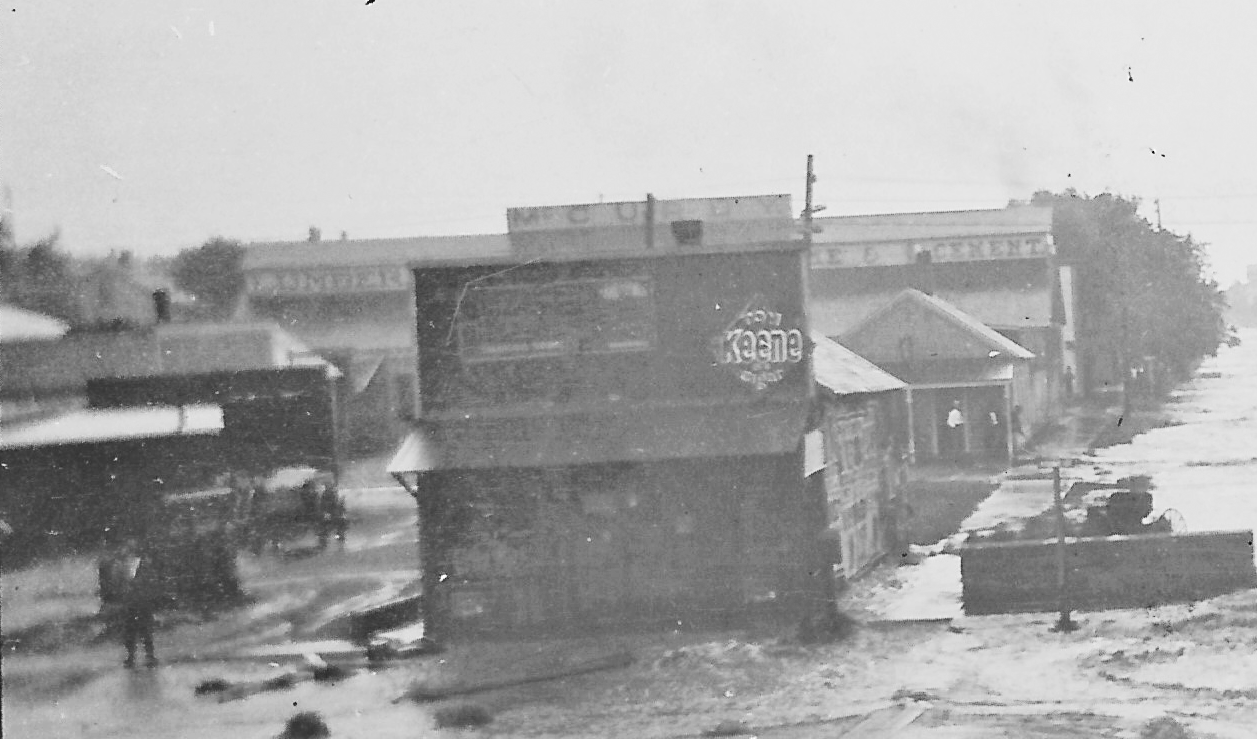
In this photo taken from the Third Ward School looking southeast, you can see the backside of the McCurdy facility. This was when Walnut Street continued west beyond Third Avenue.
Photo courtesy Ford County Historical Society
The Anawalt-Campbell Mercantile Company bought the business in September of 1909.
The Dodge City Kansas Journal, September 10, 1909
The 1911 Sanborn shows a further expanded lumber yard and the removal of all residential structures. It’s difficult to make out but this 1911 postcard shows the main building still bore the McCurdy name.
Postcard courtesy Ford County Historical Society
UPDATE: This photo was taken from a slightly better angle and shows some of the sheds on the property.
Photo courtesy Paul Kornechuk, III
Anawalt-Campbell continued to grow during the teens. The 1918 Sanborn shows a large brick building taking up the entire block between Chestnut and Walnut Streets and Third and Fourth Avenues.
CEO Ben B. Anawalt died at his Wichita home in August of 1938. His son-in-law, Frank Frantz, continued managing the Dodge City location.
Polk’s Dodge City (Ford County, Kans.) Directory 1953
If you squint, the Anawalt-Campbell Lumber Co. sign is barely visible on top of the enormous building at the upper right in this circa 1957 photo.
Photo courtesy Ford County Historical Society Dodge City Daily Globe Collection
Anawalt-Campbell closed their Dodge City location around 1960 and the building sat vacant for a couple years. It was then demolished and Fourth Avenue was closed to make way for Boot Hill Museum’s expansion of the Front Street Replica, which began in early 1964.
In this photo, you can see the west end of the demolition process with Fourth Avenue no longer a through street.
Photo courtesy Ford County Historical Society Studio de Lari Collection
This is how the block looked in September of 1969.
Photo by Russel Lupton courtesy Ford County Historical Society
And here’s the former lumber yard today:
As you all know, this block is a bit of a wreck right now but it’s also a good time to walk around and see the changes. I know the downtown merchants would appreciate the foot traffic!
If you like what you see, be sure to subscribe (way at the bottom of the post on mobile devices) to receive an email each time a new post is published and share on social media. You can also support my work by donating below. This content is 100% funded by history fanatics such as yourself. Thanks for reading!
Some of you have requested additional donation options. If you would like to send a direct donation, you can now do so by clicking here.
Donation
Your support keeps the content flowing! Make a one-time donation. Your contribution is appreciated!
It’s startling when a building you’ve taken for granted your entire life suddenly gets wrecked. All it takes is a little Kansas weather to rip your complacency to shreds.
The lots at the southeast corner of First Avenue and Maple Street were vacant until the mid-1880s. The 1887 Sanborn Fire Insurance Map shows a small feed yard where First Avenue dead-ended at Maple. By 1892, the lots were again vacant.
The 1905 Sanborn shows a residential area with a frame dwelling and large barn at what was then 615-616 Maple Street. Street numbers were standardized around 1909 and this property was assigned 117 Maple Street.
Brothers William and Edison Rhinehart built a grain elevator just south of this corner in 1923. They also sold bulk coal, salt, oyster shells, and livestock feed.
The Dodge City Journal, November 8, 1923
Offices were added to the north end of the elevator in early 1924.
The Dodge City Journal, January 3, 1924
The 1926 Sanborn shows the Rhinehart Brothers Grain and Coal Co. with a rail siding through the south alley in addition to the siding which ran down the middle of Maple. A new three-story addition measuring approximately 20 x 14 feet was completed in 1927, which made room for the machinery needed to grind and mix feed.
In March of 1940, William and his wife, Nellie, were involved in a car accident about 12 miles south of Dodge City. Nellie was killed and the building was sold shortly thereafter.
The Hutchinson News, March 28, 1940
Fairmont Creamery expanded into the former Rhinehart building in the early 1940s, using it for their feed and hatchery departments. Additional concrete block buildings were added to the east along both rail sidings. By this time, the original elevator dock area was assigned a street address of 110 First Avenue.
Around 1957, Fairmont vacated the building and it became occupied by the (Floyd T) Harris & Sons Hatchery. Harris & Sons relocated to 14th and Beeson around 1960 and the Casterline era began.
Interestingly, this 1961 promo guide claimed the Casterline & Sons Seeds facility was the oldest grain elevator in Dodge City, which was still standing. That was false. The older Davidson elevator at Sycamore and Sunnyside was built in 1915.
“Howdy” Dodge City Greeter Guide, Kansas Centennial Edition, 1961
This aerial view looking southeast toward the river shows the Casterline facility southeast of the flour mill and directly east of Fairmont.
Photographer Unknown
Looking northwest, you can see the warehouse addition, which curved along the old rail siding at the south end.
Photographer Unknown
The Casterlines owned the building for many years after the elevator ceased operations. It became occupied by Southland Industrial Supply and then sat on the market for several years.
Although this listing is no longer active, you can still click through the photo gallery to see several interior and exterior photos. If you look at the Street View on Google Maps, you can scroll through images of the property going back to 2007.
The elevator was severely damaged by storms in the summer of 2023 and partial demolition was required. The office area has been gutted and work appears to be in progress for reuse.
This is how the property looks today:
I’m glad most of the building was saved and sincerely hope it is restored to a more historical appearance. Those windows are just too much for color TV.
If you like what you see, be sure to subscribe (way at the bottom of the post on mobile devices) to receive an email each time a new post is published and share on social media. You can also support my work by donating below. This content is 100% funded by history fanatics such as yourself. Thanks for reading!
Some of you have requested additional donation options. If you would like to send a direct donation, you can now do so by clicking here.
Donation
Your support keeps the content flowing! Make a one-time donation. Your contribution is appreciated!
It feels weird to write about such a well-known building. What am I going to tell you that you don’t already know? For starters, McCarty Hospital was actually built by Nicholas Klaine in 1886 to serve as a hotel. You may remember that Klaine was a politician, judge, postmaster, and newspaper publisher. He also built the Cimarron Hotel, which looks very similar to the old hospital.
Construction of the three-story building with 30 rooms and a Mansard roof began in February of 1886.
The Dodge City Democrat, February 27, 1886
Sallie Markham Davis previously operated the Markham House at a different location on Front Street and Klaine’s new hotel would use the same name.
The Dodge City Times, March 18, 1886
Although a fundraising dinner for the Baptist Church was held at Markham House that April, it wasn’t fully completed and open for business until May of 1886.
The Sun, May 6, 1886
At the time, the lot to the north of the Courthouse was far removed from “all dust and noise.”
The Globe Live Stock Journal, May 18, 1886
It didn’t take long for the hotel to change hands. By September of 1886, William Edwards and Kate Walden were in charge of the Markham.
The Dodge City Times, September 9, 1886
William States took over operations in January of 1887 and renamed it the Central Hotel. States purchased all furniture and fixtures. He also operated a free shuttle to and from “all trains.”
The Dodge City Times, January 20, 1887
The 1887 Sanborn Fire Insurance Map shows the Central Hotel at what was then 303 Spruce Street. It lists the hotel as being two and a half stories rather than a full three due to the Mansard.
Management turnover continued with E. F. Raines taking charge in July of 1887. The Central Hotel changed hands numerous times and was refurbished by Mrs. J. Wells in late 1901.
The Dodge City Democrat, November 1, 1901
In May of 1905, Doctors Thomas and Claude McCarty announced plans to remodel the old Central Hotel into a hospital. They added a fourth floor by digging out a stone basement level and installed an elevator. Work was completed in August of 1905.
The Journal-Democrat, August 25, 1905
Although several doctors had offices which were referred to as hospitals, the McCarty building was the first proper hospital in Dodge City.
The Journal-Democrat, August 10, 1906
The 1911 Sanborn was the first to show the newly enlarged McCarty Hospital with its new street address of 104 W Spruce Street.
Postcard courtesy Ford County Historical Society E. E. Frank Collection
In May of 1922, the Sisters of St. Joseph began managing McCarty Hospital, which was renamed St. Anthony’s. After SSJ assumed operations of the former Thompson-Pine Hospital, it became known as St. Anthony’s North the old McCarty Hospital was called St. Anthony’s South.
The new St. Anthony’s Hospital at Central and Comanche opened on May 28, 1926 and the old McCarty Hospital was closed. However, Dr. Claude McCarty still had an office in the building in 1930.
Meanwhile, commercial buildings were constructed nearby. M. J. Williams operated his REO dealership at 701 Central Avenue by 1928. The former hospital was demolished around 1931 and Williams Motor Company expanded its garage into that space.
The Catholic Advance, February 21, 1931
The 1932 Sanborn shows the Williams Motor Co. building had been reconfigured to include a filling station on the corner.
W. T. Nicholson’s Super Service Station occupied the corner buildings by February of 1933.
The Catholic Advance, February 11, 1933
It’s kind of amazing that Dodge City had a 24-hour repair service in the 1930s.
Photo by Hoover Cott courtesy Ford County Historical Society
It seems strange that Nicholson claimed to occupy the busiest corner in town but we must remember that Central Avenue was also Highway 50 once upon a time.
By 1962, the Super Service building was vacant. That changed when the First Federal Savings and Loan Association of Dodge City grew out of its space on Gunsmoke Street. They constructed a modern building at Central and Spruce in 1965.
The Southwest Kansas Register, May 26, 1966
The institution’s name had changed to Landmark Federal Savings Association by February of 1985.
Sou’Wester, 1986
Then the 1990s happened and banking got weird. Multiple entities were created and merged out of existence. Landmark Bancshares, Inc. and MNB Bancshares, Inc. became Landmark Merger Company, which then became Landmark Bancorp around 2001. The institution is now known as Landmark National Bank and it continues to operate on the same corner.
Landmark’s drive-thru is in the spot where McCarty Hospital once stood. Here’s how it looks today:
I don’t want to make you feel old but the Landmark building is now eligible to be reconsidered as a contributing structure in the Dodge City Downtown Historic District. Time flies!
If you like what you see, be sure to subscribe (way at the bottom of the post on mobile devices) to receive an email each time a new post is published and share on social media. You can also support my work by donating below. This content is 100% funded by history fanatics such as yourself. Thanks for reading!
Some of you have requested additional donation options. If you would like to send a direct donation, you can now do so by clicking here.
Donation
Your support keeps the content flowing! Make a one-time donation. Your contribution is appreciated!
Usually, I choose to write about buildings when I stumble across old photos and wonder about their histories. In this case, I began researching an old hotel building and spent months trying to locate a photo to prove it existed.
Once upon a time, a small creek crossed Second Avenue between Maple and Pine Streets. The 1884 Sanborn Fire Insurance Map shows an empty lot directly south of this creek on the west side of Second Avenue.
It is believed that brothers James and William Weeks of Kinsley built four adjoining wood frame buildings on those lots south of the creek around 1885. The brothers were in the cattle business and built a successful lumber yard south of the railroad tracks.
B. Harris & Co. from Warrensburg, Missouri opened a hide business in the northernmost building in January of 1886.
The Dodge City Times, February 4, 1886
N. G. Healy & Co. bought the hide business in May of 1887, at which time Harris relocated to St. Louis. The 1887 Sanborn shows a row of wood frame structures from 208-211 2nd Avenue with only the hide house occupied. By 1892, all but the south part of the building was used for grain storage.
It is said that John Ridenour had the two south buildings dismantled and transported to his place northwest of town, where he used the lumber to construct a home. The 1899 Sanborn shows only the two north sections at 210-211 Second Avenue remained, which were being used as a boarding house.
Albert and Laura Fasig bought the boarding house and opened the Grove Hotel in May of 1902.
The Globe-Republican, May 15, 1902
The 1905 Sanborn shows the creek and bridge had disappeared. It is unclear why but I did find stories about wells drilled into the underflow which fed it, and that water could have simply been used up.
Albert Fasig died in January of 1910 and Laura advertised the 21-room Grove Hotel for sale that September. A couple of deals fell through and Robert and Zella Covalt of Emporia assumed operations by May of 1911. By this time, the block had been renumbered and the address was 107 Second Avenue.
The Dodge City Globe, May 18, 1911
The Covalts apparently had some miscommunications because Robert was arrested the following month after being accused of forging his wife’s name on a mortgage.
The Dodge City Globe, June 8, 1911
There were a lot of comings and goings. Zella divorced Robert, who had problems with alcohol, but it appears she still managed the hotel off and on even after putting it up for sale in July of 1914. Zella said she wanted to leave the area due to her health but the Grove remained on the market for quite some time.
In the meantime, Dodge City attempted to clean up its appearance. A “bullet scarred” sidewalk in front of the Grove was ordered removed in December of 1914. In reality, the holes in the iron sidewalk were from rivets rather than bullets. The metal had been repurposed from an old standpipe.
The Dodge City Daily Globe, December 31, 1914
W. H. Hampton (Bud’s father) bought the Grove Hotel in May of 1915 with plans for a complete renovation.
The Dodge City Daily Globe, May 10, 1915
This photo is a somewhat grainy copy of the original. It appears someone attempted to enhance the lettering above the entrance of the hotel.
Photo courtesy Ford County Historical Society Robert E Eagan Collection
The end of the Grove Hotel came in September of 1926 when the uninsured building was severely damaged in a fire.
The Southwest News, September 23, 1926
From that point on, the building was once again used for a variety of commercial businesses including the South Side Barber Shop.
The 1932 Sanborn shows a new rail siding had been installed across Second Avenue where the creek had once been.
The old hotel was home to a couple pool halls in the late 1930s and early ’40s. By 1947, it was occupied by Diehl’s Shoe Service and Coltran’s Upholstering. Clifford Coltran planned to restore some of the rooms in May of 1947 to celebrate Dodge City’s Diamond Jubilee. It is unclear whether his plans materialized.
The Advance Register, September 7, 1951
By 1953, Behee Mattress Company occupied the south part of the building. They were joined by Joe Gaut, owner of Gooch’s Shoe Shop by 1955. Gaut was the last tenant and the building was completely vacant after the flood of 1965. It was finally demolished in the 1970s.
This is how the former hotel site looks today:
The next time you’re driving south on Second Avenue, imagine how it looked before the flood completely altered the landscape.
If you like what you see, be sure to subscribe (way at the bottom of the post on mobile devices) to receive an email each time a new post is published and share on social media. You can also support my work by donating below. This content is 100% funded by history fanatics such as yourself. Thanks for reading!
Some of you have requested additional donation options. If you would like to send a direct donation, you can now do so by clicking here.
Donation
Your support keeps the content flowing! Make a one-time donation. Your contribution is appreciated!
Until very recently, I hadn’t spent much time on this building because I thought I knew all about the history of Boot Hill and so did everyone else. I was wrong.
It’s pretty common knowledge that the Boot Hill Cemetery was in use from 1872 until 1879 but it wasn’t an official cemetery and the body count has been exaggerated many times over by enthusiastic storytellers. People of stature in the community were buried in the cemetery at Fort Dodge. Those who died suddenly (with their boots on) as well as people without money for proper burials were illegally laid to rest on Boot Hill.
Ford County Globe, April 23, 1878
The more conservative legends say there were some 36 cowboys and one woman buried on Boot Hill. Alice Chambers, who died of natural causes on May 5, 1878, is believed to have been the last person buried on Boot Hill.
As Dodge City grew, it became clear that something had to be done about the makeshift cemetery, which occupied prime real estate. Prairie Grove Cemetery was established in the 1400 block of Avenue C extending west toward Avenue B in 1878. In those days, that area was far removed from the city center.
Herman Fringer and Samuel Marshall bought the Boot Hill property in the Spring of 1878 with plans for development.
Dodge City Times, May 4, 1878
The approximately 20 remaining bodies were ordered to be removed from Boot Hill but that would be a really disgusting job during the summer months. In January of 1879, the City agreed to pay $100 to have the bodies moved to Prairie Grove with the provision that the work be completed within 60 days.
The original Third Ward School, built from 1879 to 1880, was a 30’ x 60’ two story brick building that stood at the top of the hill.
Photo courtesy Ford County Historical Society Studio de Lari Collection
According to Robert M Wright, the original school cost $6,300 to build and the roof was already leaking a year after completion. After five years, it was braced by rods. This poorly constructed building was condemned in 1889 and torn down to make way for its bigger and better replacement.
The second and more ornate Third Ward School was overcrowded almost as soon as it opened for the 1890-91 school year.
Photo courtesy Ford County Historical Society E. E. Frank Collection
For several years, the building was used as a high school and ward school combined. Dodge City didn’t build a dedicated high school until 1914. Overcrowding continued and Lincoln Elementary School on Cedar Street was built as a spacious and modern replacement. I’ve read in a few places the second Third Ward School was demolished in 1927 but it appears that didn’t occur until 1928, when Mann and Company began working on plans for a new City Hall.
The Hutchinson News, April 13, 1928
Dr. Oscar H Simpson, Dodge City’s dapper dentist, took up sculpting in his later years and used Joe Sughrue as a model for what would become the famous cowboy statue on Boot Hill. Most of you know that Sughrue nearly suffocated when his breathing straw was pinched during casting of the cowboy’s head. The statue was unveiled by Simpson’s daughter, Betty, on November 4, 1929.
There’s a lot of confusion about what all took place on this date during the Last Roundup. Ham Bell organized a giant five-section parade with four bands plus a drum corps. School was dismissed so kids could ride their decorated bicycles in the parade, which was led by the Dodge City Cowboy Band under direction of Otero Beeson.
During the celebration, the cowboy statue was dedicated and the cornerstone was laid for the new City Hall. Newspaper articles about the event were poorly written so people have taken them to mean the building was completed. In reality, construction was just beginning at that time.
It should be no surprise that Julian Parham’s company was awarded the building contract. Sadly, Parham died on December 31, 1929 after suffering severe burns in a gasoline stove explosion at a tourist camp in Oklahoma. This photo was taken before the roof was completed.
Photo courtesy Ford County Historical Society Studio de Lari Collection
Dodge City Fire Department found themselves in a bit of a pickle while waiting for their new home to be finished. The lease was up on the place they had rented for several years so they were forced to occupy the new building while it received finishing touches. DCPD had the same problem and moved in right behind them. The new City Hall was completed by mid-February of 1930.
A buffalo head carved out of limestone, which had been saved from the old City Hall building, was placed over the door seen in this photo.
Photo courtesy Ford County Historical Society Studio de Lari Collection
In June of 1932, Dr. Simpson’s statue of two steer heads was unveiled by his daughter, Betty, during the Kansas Lions Convention. It has been reported that the event was a Rotary Convention but contemporaneous articles clearly stated this was held by the Lions organization.
The Hutchinson News, May 10, 1932
The Hutchinson News, May 17, 1932
The Wichita Eagle, May 25, 1932
The Hutchinson News, June 2, 1932
Are they oxen or steers? It turns out they are both. Before specialized breeding, oxen were simply regular old cattle put to work.
To add dramatic effect, Simpson also cast some cement death masks and cowboy boots which he partially buried near the statue at the top of Boot Hill. These “graves” were extremely popular with locals and visitors alike, so they were left in place for decades.
Photo courtesy Ford County Historical Society Troy Robinson Collection
The City Hall building served all departments until most moved to the old Methodist Church property in 1965. Left behind on the hill were the police and fire departments as well as the dog warden.
Photo courtesy Ford County Historical Society Studio de Lari Collection
The police department relocated to the new City Hall on First Avenue in 1971. Dodge City Fire Department’s new Station #1 was dedicated in May of 1990 and from that point, they only used the old building for storage and training.
The Dodge City Area Chamber of Commerce and the Convention and Visitors Bureau took up space in the former City Hall until the mid-1990s. After that, CASA occupied the space until around 2001. By that time, the massive building was in need of serious repairs.
In addition to dangerous asbestos which had to be removed, the tile roof had been leaking so there was a lot of interior damage. The building also had to be made accessible according to current building codes. The City nearly tore it down.
Photo courtesy Boot Hill Distillery
Photo courtesy Boot Hill Distillery
Photo courtesy Boot Hill Distillery
Photo courtesy Boot Hill Distillery
As most of you know, Hayes Kelman and crew had a great idea for the decaying building and renovations began in April of 2015. Boot Hill Distillery opened in 2016 and continues to operate in this beautiful, historic landmark.
I’m not sure if the building would have been saved if the City hadn’t wisely chosen to reallocate funds budgeted for demolition to the restoration process. It’s important to acknowledge the changing attitude toward our historic landmarks. I would also note that the statues on the property have undergone some pretty serious repairs and restorations, which were sorely needed.
Here are a few relatively recent exterior photos:
This building was neglected and disrespected for far too long. Its transformation is a shining example of what is possible. But don’t take my word for it! The tasting room is open Wednesday to Saturday from 3-11 pm and tours (yes, tours!) are available Fridays and Saturdays at 4 and 6 pm.
If you like what you see, be sure to subscribe (way at the bottom of the post on mobile devices) to receive an email each time a new post is published and share on social media. You can also support my work by donating below. This content is 100% funded by history fanatics such as yourself. Thanks for reading!
Some of you have requested additional donation options. If you would like to send a direct donation, you can now do so by clicking here.
Donation
Your support keeps the content flowing! Make a one-time donation. Your contribution is appreciated!
In my story about Soule College, I explained that the Methodist Episcopal Church used funds from that sale to build a new church. The congregation had outgrown their building at what was then 804 First Avenue so they made plans for new construction right next door at the southwest corner of First and Vine.
The 1887 Sanborn Fire Insurance Map shows the old M. E. Church with a frame dwelling located on the lot to the north at 805 First. The only significant change to the property prior to the new construction was the street number standardization, which took place around 1909. These lots were assigned new addresses of 715 and 719 First Avenue at that time.
In July of 1912, the church board of trustees voted unanimously to construct a new church building with the cost not to exceed $25,000.
The Dodge City Daily Globe, July 27, 1912
The church’s parsonage on Avenue B was traded to Ira and Lottie Beck for the corner lot with the agreement that the Becks would have the house removed.
The Dodge City Kansas Journal, August 23, 1912
Kansas City architect William F Schrage was selected to design the new building, which included a total seating capacity of around 1,000.
The Dodge City Daily Globe, August 30, 1912
The Dodge City Daily Globe, August 30, 1912
The 70′ x 90′ building was to include a Sunday school room, 15 classrooms, and a pastor’s study. A gymnasium, social room, and heating plant would be located in the basement.
The Dodge City Daily Globe, September 6, 1912
The funds from the Soule College sale didn’t come close to paying for the building. A financial rally was held on October 20, 1912 with the goal of raising the remaining $15,000. Emery Beck removed the house from the corner lot to a new spot on his farm, allowing excavation by Sam Bagley to begin in November. The church planned to use lumber from their old building to construct a parsonage once the new building was occupied.
After slight alterations to the plans, the construction contract was awarded to Julian Parham and L. J. Upp with a completion deadline of September 1, 1913.
The Dodge City Daily Globe, December 9, 1912
Stained glass costing around $500 was ordered from the Kansas City Art Glass Company in January of 1913. Circular pews and other seating were provided by the American Seating Company of Grand Rapids, Michigan. Misner Plumbing Company submitted the winning bid for the heating system at $1,400.
The Dodge City Kansas Journal, January 17, 1913
Brickwork began in February of 1913 but progress was slow due to poor weather conditions. Windows and flooring were installed in July. Fundraising efforts were ongoing throughout construction.
Although it wasn’t completely finished, the first service was held in the new church building on August 31, 1913. The building was used for various daytime meetings and events but nothing could be scheduled during the evenings because lights hadn’t yet been installed.
October 19, 1913 had been the target date for dedicating the new church building. However, the church board decided to wait until the building debt was nearly repaid. The ceremony finally took place on May 31, 1914 without a pipe organ. Due to the flood of donations at the dedication, a $3,000 Pilcher pipe organ was ordered at once. The organ was officially unveiled during a celebratory concert on December 29, 1914.
The Dodge City Daily Globe, December 30, 1914
In 1915, the new frame parsonage was built on the site of the old church for approximately $3,300.
The 1918 Sanborn was the first to show the new building at 719 First with the new parsonage and a detached garage next door to the south.
In August of 1928, contracts were awarded for a new Sunday school and office building to be constructed along the alley at the back of the lots. Once again, Julian Parham was the builder and the expected cost was $65,000.
The Hutchinson News, August 10, 1928
The church was still growing and needed additional space. A new parsonage was built around 1954, which was attached to the front of the office. Shown here is the new parsonage to the left of the church.
Photographer Unknown
This photo shows a bit more detail of the beautiful church building.
Photographer Unknown
To the right in this photo, you can see the back side of the education building with the church connected at the north end. Both had walk-out basements, making them appear to be three stories tall.
Photo courtesy Ford County Historical Society Studio de Lari Collection
The church was still growing, however, so they built a new facility in 1964. The property on First Avenue was sold to the City of Dodge City for use as the new City Hall and police station. Those cruisers had to be parked somewhere so the beautiful church was demolished and replaced with a parking lot. Because of course it was.
Around 1990, the City built the new police station across the street from the old church and City Hall moved to the old Southwest Clinic. Since that time, the former parsonage and education building have housed all sorts of businesses from attorneys to accountants to medical offices. I can’t remember the last time I saw the parking lot full.
These photos were taken about a year ago.
I’m not a zoning reform absolutist but we have a lot of parking lots, folks. We also have a multilevel parking garage that is falling into ruin.
If you like what you see, be sure to subscribe (way at the bottom of the post on mobile devices) to receive an email each time a new post is published and share on social media. You can also support my work by donating below. This content is 100% funded by history fanatics such as yourself. Thanks for reading!
Some of you have requested additional donation options. If you would like to send a direct donation, you can now do so by clicking here.
Donation
Your support keeps the content flowing! Make a one-time donation. Your contribution is appreciated!